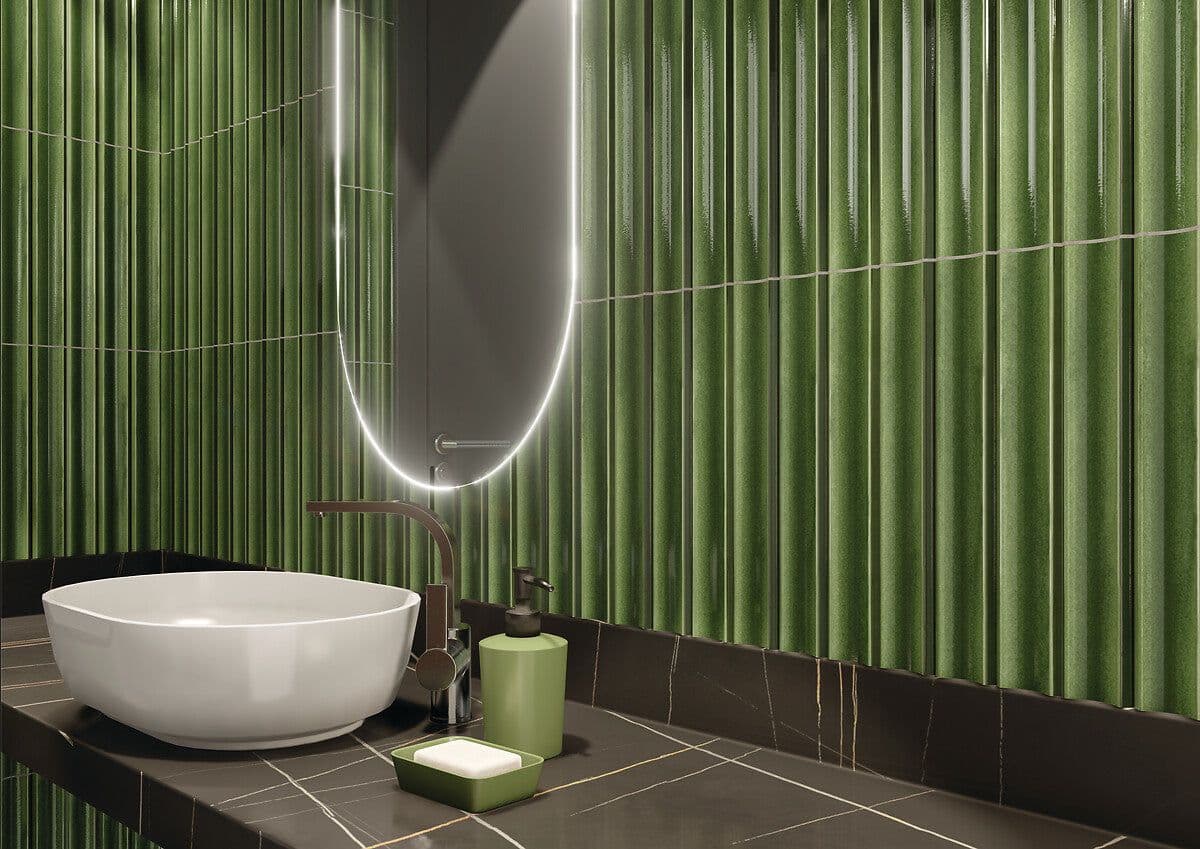
3D wall tiles do far more than provide a backdrop.
Instead, 3D tiles introduce depth, shadow and tactile richness to a space in a way that a flat tile cannot replicate.
Often used to create a feature wall or transition space, 3D tiles can feature endless dimensional variations.
At Parkside, you’ll find a wide selection of 3D tiles within our product ranges.
In this post, we’re here to inspire your next commercial project with us by introducing you to some of our 3D tiles and also guiding you on some of the best use cases.
3D Tiles: An Overview

The term 3D tile covers a fairly broad range of products. However, the defining characteristic of a 3D tile is that the tile surface is not flat. Instead, it has a three-dimensional profile that is either pressed into the tile body during manufacture, carved or formed through the glaze application.
3D Feature Wall Tiles: Design Characteristic Examples
Geometric relief tiles are among the most widely specified in contemporary interiors.
Repeating geometric forms can include hexagons, diamonds, chevrons, overlapping scales or angular faceted surfaces. Each type creates a pattern across the wall that shifts with the light. The appeal lies in the way a single tile, repeated across a wall, generates a complex visual rhythm without any variation in the tile itself. Geomtetric tiles are particularly prevalent in hospitality, retail and high-end residential interiors.
Another popular 3D tile style is fluted or ribbed tiles, which have seen significant growth in specification over recent years, driven by the broader trend for fluted surfaces across furniture, joinery and architectural details. Vertical or horizontal parallel ridges create a strongly directional surface that works well in both contemporary and transitional interiors.
Elsewhere, 3D tiles can move away from geometric precision towards softer, more organic textures like waves. These tend to be used as feature wall applications rather than all-over wall coverings, given the visual intensity of a large area of organic relief.
Where 3D Wall Tiles Are Specified

In commercial and hospitality interiors, 3D tiles most commonly appear as feature walls behind bars and reception desks, in restaurant dining areas, hotel bedroom headwall applications, spa and wellness environments. 3D tiles are also popular in retail fitting rooms where sensory richness and visual interest are part of the brand experience.
In residential interiors, bathroom feature walls, particularly behind freestanding baths or as a shower back wall, are the most common application.
The common thread across all of these applications is the use of the tile as an architectural surface rather than simply a background material. This enables the tile to contribute actively to the spatial quality of the room rather than receding behind it.
Shop the look:
3D Wall Tile Examples From Parkside
At Parkside, we supply a wide selection of 3D tiles spanning various tile profiles, sizes and colours.
If you are considering using 3D tiles in your next commercial tiling project, our technicians can run you through all of the available options. Beyond aesthetic preferences, the most suitable tile should also be carefully matched to its environment as part of the specification process.
In the meantime, here is a snapshot of our 3D tiles. We’ve included a link underneath each range where you can view more details and order a sample tile for your project.
Apex

Glazed porcelain with angular ridges can give your walls a 3D quality. Use dramatic lighting across the surface to emphasise the beautiful glaze and structure of the tiles.
Shop the look:
Canti

Canti is an extraordinary range of 3D wall tiles across 7 colours, 2 designs and 2 finishes. Ideal for creating a sophisticated statement on any wall.
Shop the look:
Camden

A beautiful curved 3D effect tile, in a range of six colours will give your walls elegance with a dynamic edge. Sensations of light and shadow play across the surface giving a dramatic effect. The range can be used both internally and externally.
Shop the look:
Enis

Enis mixes the classic texture of slate with a modern colour palette. This slate effect indoor & outdoor collection is available for indoors in 2 sizes and 3 neutral colours and has a PTV 36+ finish. The outdoor 20mm tiles available in the Everscape range come in all 3 colours and 3 formats making it a great solution for indoor/outdoor projects.
Shop the look:
Fenman

The Fenman collection leans toward the more traditional aesthetic with rustic edges, colour variation and undulated surfaces but features a modern twist with the curved 3D tile options.
Shop the look:
Using 3D Tiles Effectively

Shop the look:
Use Them To Define Zones In Open Plan Spaces
In open-plan commercial or residential interiors where spatial definition is achieved through material change rather than physical partitions, a 3D tile feature wall can function as an architectural marker. 3D tiles can be used to signal a transition between a dining area and a bar, a reception zone and a corridor, a bedroom sleeping area and a dressing or bathing space. The relief surface draws the eye and anchors the zone without requiring any change in floor level, ceiling height or structural element.
Don’t Overuse
A single well-chosen feature wall in a relief tile will command attention and anchor the design of a room. The same tile on all four walls typically produces a busy result. As a rule, one feature wall per space is the right starting point, with remaining surfaces in a complementary flat tile or paint finish that allows the relief wall to breathe.
Consider The Light Source
Before selecting a profile, establish where the light is coming from including what kind of light it is. A deeply faceted geometric tile on a wall that receives strong directional sunlight from a side window will be spectacular. The same tile on a wall that faces away from the light source, or in a room that relies on recessed downlights directly above, may appear flat and disappointing. Where natural light is limited, consider supplementing with wall wash lighting or angled track spotlights positioned to rake across the surface.
Scale The Profile To The Space
Relief depth and tile format should be proportionate to the size of the wall and the room. A deeply sculpted large-format tile on a small bathroom feature wall can feel overwhelming, as the profile is too dominant relative to the surface area. In a compact space, a subtler relief or a smaller tile format with a shallower profile will typically produce a more resolved result.
Resolve The Corners
How a 3D tile wall terminates at its edges and corners is one of the most important details in a relief tile installation. Various options exist here, including using a purpose-made corner piece where the manufacturer offers one. However, the chosen solution should not be left to the installer to resolve on site. Instead the approach should be decided at the design stage, confirmed with the tile supplier and detailed on the installation drawings.
Coordinate Grout Carefully
Grout colour on a relief tile wall deserves more thought than on a flat tile application because it affects the way the relief reads. A grout that closely matches the tile body will keep attention on the profile and the play of light across it. In most architectural 3D tile applications, a tone-on-tone or matching grout is the right choice, unless the grid itself is a deliberate design element. Joint width should be as narrow as the tile format and rectification allow, as wide joints on a relief tile wall can look unresolved and draw attention to the installation rather than the tile.
Combine With Complementary Flat Tiles Thoughtfully
The most effective 3D tile schemes tend to use the relief tile in dialogue with a carefully chosen flat tile rather than in isolation. A matt flat tile in a tone pulled from the relief tile's glaze, used on the floor or adjacent walls, will ground the scheme and allow the feature wall to read clearly. A flat tile that is too similar in colour and finish to the relief tile risks making the whole scheme feel monotonous; one that is too contrasting risks making the relief wall feel disconnected from the rest of the space. The flat tile should support the feature wall without competing with it.
Never Compromise On Specification
3D tiles are increasingly used in shower enclosures, spa environments and pool surrounds. However, it is important to remember that in these environments, the technical specification requirements outlined for commercial wet areas still apply in full, regardless of the aesthetic ambition of the project.
Discuss Your 3D Tile Requirements With Our Commercial Tile Specialists
Are you looking to incorporate 3D wall tiles within your next commercial tiling project?
Parkside has a wide range of 3D tiles to choose from, spanning various sizes, textures and colours. Our 3D tile samples can also be ordered directly on our website.
Whether you are designing a hotel feature wall, a restaurant interior, a spa environment, or a statement bathroom in a premium residential project the Parkside 3D tile range gives you the technical performance and aesthetic depth to deliver a result that stands apart.
For help in landing upon the right 3D tile specification, please send us a message or call us on 0116 276 2532.
Our 3D tiles are also available to view in person at our studios based in Glasgow, Leicester, London and Manchester.

