When you are looking to purchase wall tiles or floor tiles for a commercial project, the process works very differently to buying tiles for a home renovation project.
That’s because tiles installed in commercial settings like shops, offices, restaurants, leisure venues or hospitals all need to be specified. In short, a tile specification outlines all of the properties the tile must possess to ensure it is geared towards its environment. The correct specification is important for health and safety, but it also matters for long term satisfaction.
At Parkside, our tile technicians can provide you with personalised guidance about the specifications your commercial tiles may need possess.
While not intended as a substitute for our tailored advice, here is an overview of some of the most common mistakes that can happen when your tiles are incorrectly specified. We’ve also thrown in some handy tips to help you avoid the top problems.
Specifying Tiles Without Adequate Slip Resistance
Slip resistance is the single most safety-critical aspect of any floor tile specification and it is frequently underspecified in commercial settings.
Many specifiers default to a tile finish that looks appropriate without checking whether it meets the relevant performance thresholds.
In the UK, slip resistance is assessed using the Pendulum Test Value (PTV) method. A PTV of 36 or above is the accepted threshold for low slip risk in most commercial environments. Wet zones such as commercial kitchens and washrooms demand higher ratings.
How to avoid it: Always obtain the PTV rating from the manufacturer's datasheet before specifying any floor tile. Do not rely on descriptive terms such as "textured" or "anti-slip" without verification. For wet areas and commercial kitchens, cross-reference both PTV and R-ratings. The Health and Safety Executive has also published guidance on slip risk assessments, which is a useful reference point for any commercial specifier.
Choosing The Wrong Adhesive Classification
The BS EN 12004 classification system exists to make adhesive selection straightforward, yet it is routinely ignored or misapplied.
Using a standard C1 adhesive where a C2S1 or C2S2 is required is one of the most common causes of tile debonding in commercial spaces.
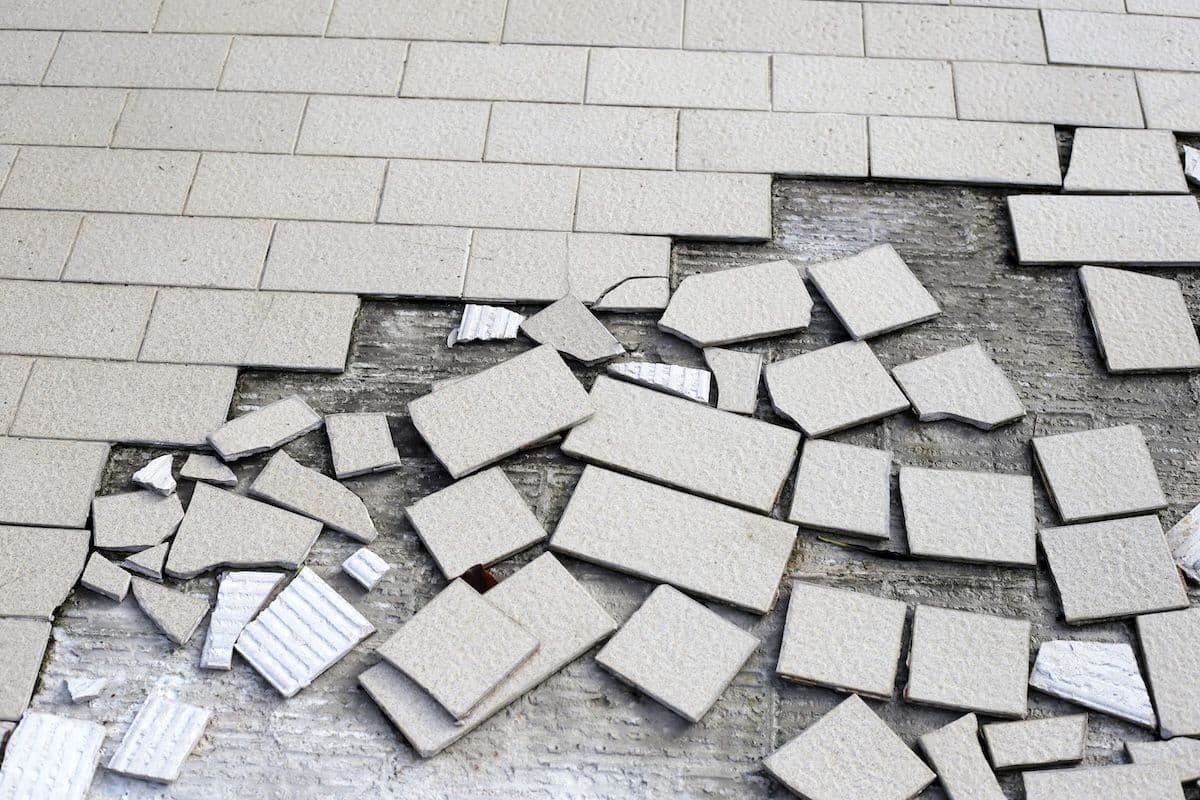
The consequences range from hollow-sounding tiles and cracked grout joints to full debonding, water ingress into the substrate and significant remediation costs. In high traffic environments, failure can progress from initial debonding to visible lift within weeks.
How to avoid it: Read the BS EN 12004 classification string on every adhesive datasheet and match it to the demands of the installation. For most commercial floor applications, a C2S1 is the minimum practical specification. Over underfloor heating, timber substrates or in external applications, C2S2 is appropriate.Large format tiles require highly polymer-modified adhesives and back-buttering should be standard practice to achieve the required contact coverage.
Ignoring Substrate Assessment
Tiles perform only as well as the surface beneath them.
A specification that devotes significant attention to tile selection and adhesive type but overlooks the substrate is incomplete. Related substrate issues include insufficient flatness, inadequate strength, residual moisture and the presence of existing adhesive or surface contaminants.
In refurbishment projects, this risk is amplified. Older screeds may be weak, delaminated or contain residual adhesive from a previous installation that has not been fully removed. Applying a new tile system over a compromised substrate simply transfers the failure into the new installation.
How to avoid it: Carry out a structured substrate assessment prior to specification. Check flatness against the tolerances required for the intended tile format. Test for residual moisture using a hygrometer or calcium carbide test and assess compressive strength where large or heavy format tiles are planned. BS 5385 provides detailed guidance on substrate requirements and is the relevant standard for wall and floor tiling in the UK.
Overlooking Movement Joint Requirements
Movement joints are a non-negotiable element of any tiled installation of significant size, yet they are frequently omitted or inadequately positioned. Without movement joints, the natural thermal and structural movement of a building has nowhere to go. The tiled surface absorbs that movement and the grout, adhesive or tile itself eventually fails.
This is particularly relevant in commercial environments where large areas are tiled in a single field, where underfloor heating introduces repeated thermal cycling or where the building structure is subject to differential settlement.
How to avoid it: Specify movement joints in accordance with BS 5385 Part 3. As a general principle, movement joints should be provided at every structural movement joint in the building, at the perimeter of every tiled field and at maximum intervals of approximately 4.5 metres internally and 3 metres externally. Movement joints must be carried through the full depth of the tile and adhesive bed and filled with a compressible sealant rather than grout.
Using Polished Or Low-Texture Tiles in Inappropriate Locations
Polished porcelain and highly glazed tiles are a popular choice in commercial interiors because of their premium appearance and ease of cleaning when dry.
However, specifying them in entrance lobbies, circulation routes or any area subject to wet or contaminated foot traffic creates a foreseeable slip hazard.
The problem is compounded in UK buildings where rain and wet footwear are a year-round consideration. Therefore, a tile with a PTV of 18 when wet is a liability, regardless of how well it performs on a dry showroom floor.
How to avoid it: Reserve polished finishes for areas with genuinely low slip risk, such as private offices, meeting rooms and wall applications. In entrance areas, specify matting systems and transition zones that manage moisture before it reaches the main floor finish. Where a polished aesthetic is required in higher-risk locations, consider anti-slip treatments or select tiles with a micro-textured surface that will maintain its appearance while achieving a safe PTV rating.
Failing To Account For Tile Weight And Loading
Large format tiles, natural stone and thick-format pavers carry significant dead loads that must be factored into the structural assessment of the floor. This is particularly relevant in refurbishment projects where the existing structure was designed to a different specification and in upper-floor commercial installations.
Failure to account for weight can result in structural overloading, excessive deflection and adhesive failure caused by movement in the substrate under load.
How to avoid it: Obtain the weight per square metre for the proposed tile system, including the adhesive bed and any levelling compound and confirm the floor's load capacity with a structural engineer where there is any doubt. For large format tiles above 60cm in any dimension, ensure the subfloor flatness tolerance can be achieved before committing to the specification.
Selecting Grout Without Considering The Environment
Grout is often treated as an afterthought, with colour selection receiving more attention than performance specification. In commercial environments, grout selection has a direct impact on hygiene, durability and the long-term maintenance burden.
Standard cementitious grout is appropriate for many internal applications, but it is not suitable for areas subject to chemical cleaning agents, prolonged moisture exposure or the demands of food service and healthcare environments. In these settings, cementitious grout degrades, stains and becomes impossible to clean effectively over time.
How to avoid it: Specify epoxy grout for commercial kitchens, food production environments, healthcare facilities and any area subject to aggressive cleaning regimes. Epoxy grout offers superior chemical resistance, stain resistance and durability. It is more demanding to apply and carries a higher material cost, but those costs are recovered many times over in reduced maintenance and longer service life. Joint width should also be minimised in hygienic environments to reduce the surface area of grout exposed to contamination.
Not Specifying For Frost Resistance In External Applications
External tile specifications must account for the UK climate, which subjects tiled surfaces to repeated freeze-thaw cycling throughout the winter months. Tiles with water absorption above 3% are vulnerable to frost damage as trapped moisture expands on freezing, causing surface spalling, cracking and debonding.
How to avoid it: For any external application, specify tiles with a water absorption rate of 0.5% or below, classifying them as impervious. Ensure the adhesive carries frost resistance certification and achieves at least S1 deformability. Movement joint provision is especially critical externally, where thermal movement ranges are significantly greater than in internal environments.
Overlooking Long-Term Tile Availability
A large commercial tiled area will almost certainly require tile replacements during its service life as a result of accidental damage, localised failure or wear in high-use zones. If the specified tile has been discontinued, finding a match is often impossible. The result is either a visible patch in a contrasting tile or a full floor replacement at disproportionate cost.
How to avoid it: Before finalising the specification, confirm the manufacturer's commitment to long-term availability for the chosen range. Purchase an agreed overage at the time of installation, typically a minimum of five percent above the net area and store it on site for future use. Document the tile reference, batch number and supplier details in the project record for future reference.
Specifying Tiles Before Confirming Programme Requirements
Standard cementitious adhesives require a minimum of 24 hours before grouting and significantly longer before the floor is returned to traffic. In live commercial environments, this may not be compatible with the project programme. Using a standard adhesive where a rapid-setting product is required can delay handover, extend disruption periods and increase the overall project cost.
How to avoid it: Establish programme requirements before specifying the adhesive system. Where rapid return to use is required, specify a fast-setting adhesive with the appropriate BS EN 12004 classification. Confirm curing times with the manufacturer under the anticipated site conditions, as low temperatures can significantly extend setting times for cementitious products.
Get Your Tile Specification Right First Time With Help From Parkside
With the above risks of making the wrong choice in mind, it’s no understatement that specifying a tile for commercial use is a huge undertaking.
For this reason, we recommend that you contact our technical experts for tailored advice.
At Parkside, we’ve supplied tiles to commercial projects across the UK, including major retail destinations like Harrods and upscale restaurants in Yorkshire. So, it’s safe to say that if you are in search of tiles for any commercial setting, your project is in excellent hands when you work with us.
You can find details of our tiles on our website. But, we can also provide you with advice when you get in touch.
To speak with our tile specification team directly, please call 0116 276 2532.
Or, you are also welcome to come and meet us in person at our design studios located in London, Manchester, Leicester and Glasgow.

