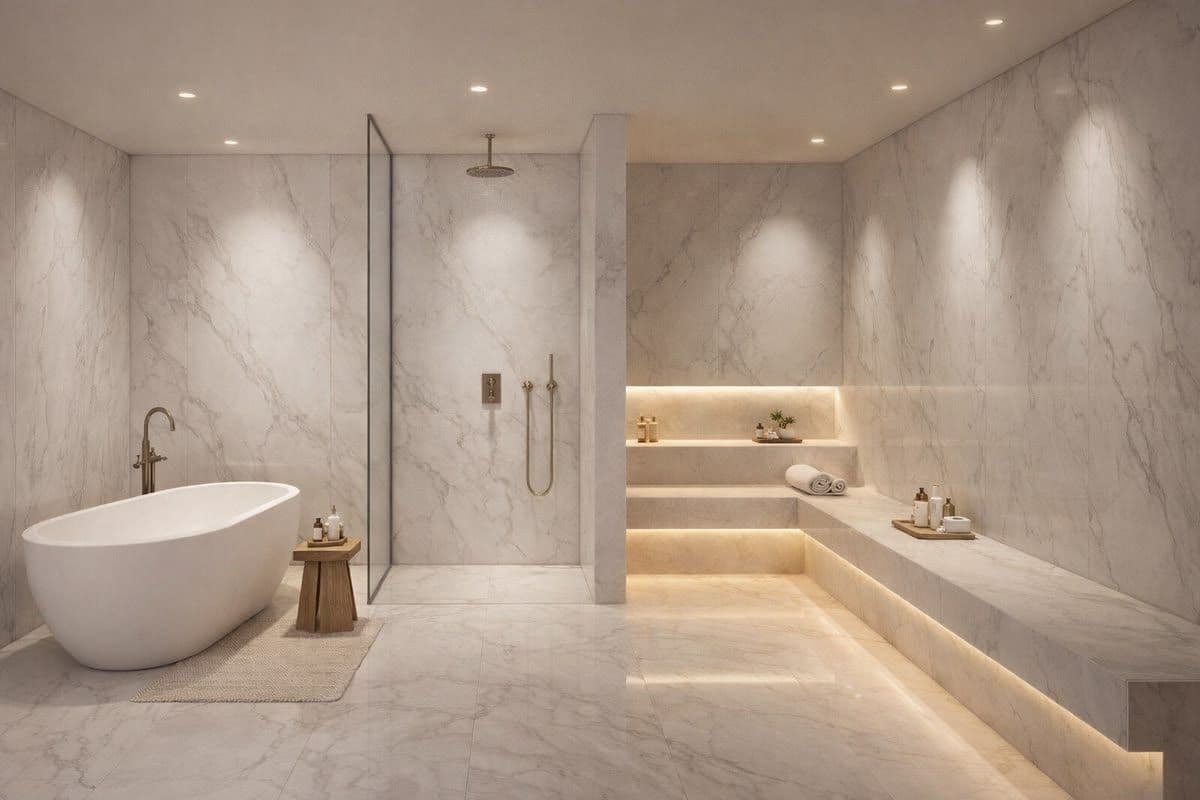
When specifying tiles for commercial use, there is always a duty to ensure that the properties of the tile reduce any increased risks that the environment may present.
In commercial wet areas such as showers, changing rooms, pool surrounds, spa facilities, kitchens, public toilets and healthcare washrooms, the primary risk relates to the increased chances of slips and trips, especially on any floor surfaces.
The service run behind a bar belongs in this category too, combining standing water with sugar, alcohol and citrus contamination. See our bar tiles collection for the PTV and grout specification this zone needs.
In these settings, aspects such as slip resistance, water management, durability under heavy use and compliance with referenced standards remain essential to get right within the tile specification.
Parkside specialises in specifying tiles for a wide range of commercial settings, including wet areas such as commercial bathrooms, kitchens and changing rooms.
While not intended as a substitute for a consultation with our professionals, we hope this information will shed light on the importance of specifying tiles to suit the increased demands that wet areas present.
Commercial Wet Areas - The Core Challenges When Specifying Tiles
Failures when specifying tiles for commercial wet areas are rarely cosmetic. Instead, they tend to manifest as slip hazards, hygiene compliance issues or structural water ingress. All of which carry liability implications, not to mention remediation costs that can far outweigh the original specification fee.
As a result, commercial wet areas present a specification challenge that goes well beyond selecting a tile that looks the part. The core difficulty lies in the number of interdependent variables that must all be resolved simultaneously.
Some of the most important aspects to check when specifying tiles for wet areas include the slip resistance, water absorption, chemical resistance, substrate preparation, adhesive and grout selection and movement joint provision.
Each of these factors is complex enough in isolation, but in a wet area, they interact with each other in ways that can result in a specification error. For this reason, careful attention is required during the specification process.
Commercial Bathrooms or Washrooms

Many commercial buildings have customer-facing wet areas. Often, this includes spaces such as hotel bathrooms, gym and leisure changing rooms, office washrooms, public toilets and healthcare facilities. These settings can have a wide range of specification requirements depending on footfall, user profile and sector-specific guidance.
However, as we’ve just established, the presence of water on the floor surface automatically shifts the specification of the tile, since aspects such as slip-resistance will be very high on the agenda. Where applicable, other liquids, such as chlorine or cleaning agents, also have to be taken into account, since the tile will need to be fully suited to its environment.
Shop the look:
Slip Resistance
The floor surface condition and user profile determine the appropriate test methodology:
- Shod wet areas (public toilets, office washrooms with footwear): PTV 36+ wet (BS 7976 pendulum test)
- Barefoot wet areas (hotel bathrooms, spa changing rooms, gym showers): PTV 36+ wet and DIN 51097 Class B or C
- Shower trays and wet room floors: DIN 51097 Class C as a minimum; the combination of standing water, soap and barefoot use makes this the highest-risk domestic-scale wet area
For accessible toilets and changing facilities, Approved Document M and BS 8300 both require slip-resistant floor finishes. PTV 36+ is the implied minimum, and specifiers working on projects with an accessibility requirement should confirm this explicitly with the tile manufacturer.
Surface texture matters alongside PTV values. That’s because a tile can pass the pendulum test but become dangerously slippery with soap residue. Structured or textured surfaces generally perform more reliably over time than polished or lapped finishes in wet areas.
Wall Tiles
Wall tiles in commercial washrooms are less structurally demanding than floors, but carry their own specification requirements:
- Water resistance: fully vitrified or Group IIa wall tiles are appropriate; glazed ceramic (Group IIb or III) is acceptable on walls above the splash zone in lower-traffic environments, but should be avoided in high-humidity areas like showers
- Glaze quality: specify Class 5 stain resistance (BS EN ISO 10545-14) in high traffic washrooms, as lower grades will show soiling within months in a commercial environment
- Chemical resistance: Class A or B against household cleaning chemicals. Will require confirmation of compatibility with the building's cleaning regime, particularly if quaternary ammonium compounds or chlorine-based products are used
Accessibility and LRV
For any commercial washroom with accessible facilities (which, under Part M, means most new commercial buildings), Light Reflectance Value (LRV) must be considered as part of the tile specification:
- A minimum 30-point LRV contrast between the floor and wall finish is required under BS 8300 and Part M guidance, to assist visually impaired users in navigating the space
- LRV contrast is also required between sanitary ware and the wall behind it, and at door frames
- LRV values must be confirmed from manufacturer data as visual assessment is unreliable, and similar-looking tiles from different manufacturers can have significantly different LRV values
- Matt finishes tend to have lower LRV than gloss at equivalent colours; this matters when mixing finishes in a single scheme
Did you know?: At Parkside, we offer a Light Reflectance Value (LRV) tile testing service.
Commercial Changing Rooms (i.e. Swimming Pools & Wet Leisure)

Wet leisure environments (and particularly swimming pool environments) are arguably the most technically demanding of all wet area tile applications. The tiles must withstand constant water immersion, pool chemical exposure and thermal cycling.
Aside from the performance specifications, colour selection also carries particular weight in pool environments. The appearance of the can vary depending on the water depth, lighting conditions and the colour of the water itself.
Bespoke and artisan options are increasingly specified in high-end residential and boutique hotel pools as a point of differentiation. That said, each option introduces additional technical considerations around consistency, lead times and installation complexity that must be managed alongside the aesthetic brief.
Shop the look:
Slip Resistance
Barefoot use throughout, combined with standing water and potentially contaminated surfaces (sunscreen, body oils), means the highest classification levels apply:
- Pool surrounds (external deck areas): DIN 51097 Class C minimum; PTV 40+ wet (pendulum test, barefoot condition)
- Pool hall floors: DIN 51097 Class C; consider PTV 45+ for areas with high footfall, such as entrance points to the pool tank
- Changing rooms and shower areas: DIN 51097 Class B minimum, Class C preferred; PTV 36+ wet
- Steps into pool tank: Class C; typically specified with contrasting colour or tactile profile to signal the step edge, per guidance in BS 8300 and pool design standards
Tiles for pool surrounds and pool tank floors are often purpose-designed products. That’s because standard architectural porcelain (even at high PTV) may not carry the appropriate durability certifications for immersion use.
Mosaics (particularly glass or vitrified ceramic mosaic at 25×25mm or 50×50mm) remain a common pool tank specification because the high number of grout joints provides inherently high slip resistance.
Water Absorption and Tile Body
For tiles subject to full or partial immersion, water absorption must be as close to zero as practical:
- Pool tank walls and floors: fully vitrified porcelain or glass mosaic, water absorption <0.5% (the tightest end of Group I)
- Pool surrounds: Group I (≤3%), with frost resistance confirmed if external or in an unheated enclosure
- Frost resistance (BS EN ISO 10545-12) is a mandatory parameter for any external pool area or indoor pool that may be exposed to sub-zero temperatures during shutdown periods
Glass mosaic tiles are widely used in pool tanks. However, they are not covered by the same BS EN 14411 classification as ceramic and porcelain tiles. Specify to BS EN 14179 (glass mosaic).
Chemical Resistance
Pool water chemistry is aggressive. Chlorine-based disinfection, pH adjustment chemicals (hydrochloric acid, sodium carbonate) and algaecides all contact tile surfaces continuously. Specify:
- BS EN ISO 10545-13: Class A resistance to pool chemicals and household chemicals
- Confirm specific resistance to chlorine concentrations at typical pool dosing levels (typically 1-3 ppm free chlorine, with shock doses up to 10 ppm)
- Grout chemical resistance is equally important as a Class A tile, with a chemically inadequate grout will fail at the joints
Additional Pool-Specific Considerations

- Thermal shock resistance (BS EN ISO 10545-9): Outdoor pools and those subject to hot water features or jet systems require confirmation of thermal shock performance
- Colour stability: Pool chemicals and UV exposure (external or in glazed pool halls) can cause colour shift in some tile types over time - confirm UV stability and chemical colour fastness with the manufacturer
- Tile size on curved surfaces: Pool tanks with curved walls or floors require smaller format tiles or mosaics to follow the geometry without excessive lippage or voids in the adhesive bed
- Anti-algae properties: Some tile manufacturers offer surfaces with silver-ion or photocatalytic treatments claiming anti-algae or antimicrobial benefits; however, these are supplementary to, rather than a replacement for, correct water chemistry management
Shop the look:
Commercial Kitchens

Commercial kitchens represent yet another demanding tile environment. Wall and floor surfaces will be subject to a combination of wet floors, thermal cycling, heavy mechanical loads and aggressive cleaning chemicals. Specification errors can result in significant consequences both for performance and for food hygiene compliance.
Shop the look:
Slip Resistance
Commercial kitchens are classified as contaminated wet areas for slip resistance purposes,meaning water alone is not the test condition. Instead, oils, fats and food debris must also be factored in.
The ramp test (DIN 51130) is the relevant standard here rather than the pendulum test alone:
- R11 minimum for general kitchen floor areas
- R12 for areas with high fat or oil contamination (frying stations, around deep fat fryers)
- R13 for areas where oils are present in significant volumes (food processing, industrial catering)
Where barefoot use occurs (unlikely in commercial kitchens but relevant in adjacent changing/welfare areas), DIN 51097 Class B or C applies.
PTV wet values should still be confirmed alongside R-ratings. HSE guidance requires PTV 36+ as a baseline for any workplace floor. A tile carrying an R11 rating from the ramp test should comfortably meet this, but confirmation on the datasheet is best practice.
Tile Body and Water Absorption
Fully vitrified porcelain (Group I, ≤3% water absorption per BS EN 14411 / BS EN ISO 10545-3) is the only realistic choice for commercial kitchen floors. The reasoning goes beyond durability:
- Low absorption minimises bacterial harbouring in the tile body itself
- Dense tile body resists fat and grease absorption
- Easier to maintain the standards required under food hygiene regulations (Regulation (EC) No 852/2004, retained in UK law post-Brexit)
For walls, Group IIa (3-6%) is technically acceptable in lower-splash zones, but specifying Group I throughout simplifies procurement and ensures consistent performance.
Chemical Resistance
This is a non-negotiable parameter in commercial kitchens. Cleaning regimes typically involve alkaline degreasers, acidic descalers and in some cases chlorine-based sanitisers. The relevant test is BS EN ISO 10545-13 (chemical resistance of glazed surfaces) and 10545-14 (chemical resistance of unglazed surfaces).
Specify tiles rated Class A (highest resistance) against both acids and alkalis. Confirm resistance to:
- Household chemicals and swimming pool salts (Class A)
- Low concentrations of acid and alkali (Class B minimum, Class A preferred)
- High concentrations of acid and alkali (Class A required for heavy cleaning environments)
Other Considerations
- Coved skirtings at floor-wall junctions are required in food preparation areas under food hygiene regulations
- Floor falls: A minimum 1:80 fall to drainage is standard; 1:60 in high-volume wash-down areas. This must be factored into the design, as it cannot be achieved with adhesive alone
- Thermal shock resistance (BS EN ISO 10545-9) is required to contend with hot water washdowns, which create thermal cycling
- Grease trap surrounds and drainage channels should be tiled with the same specification as the floor
Get A Consultation From Our Commercial Tile Experts
As an architect, designer, developer or similar professional working on a commercial tiling project, it’s essential that your project receives the expertise it deserves.
We’ve listed general examples of tile specifications for different wet commercial environments above. However, our technical experts here at Parkside can offer you tailored advice that is specific to your project. Whether you require tiles which meet the required specification for installation in a commercial wet area or something else, we’re here to help.
To contact us, please send us a message or call us on 0116 276 2532.
You can also order tile samples directly on our website. Or, you are welcome to visit any of our studios located across the UK to browse our commercial tiles in person.

