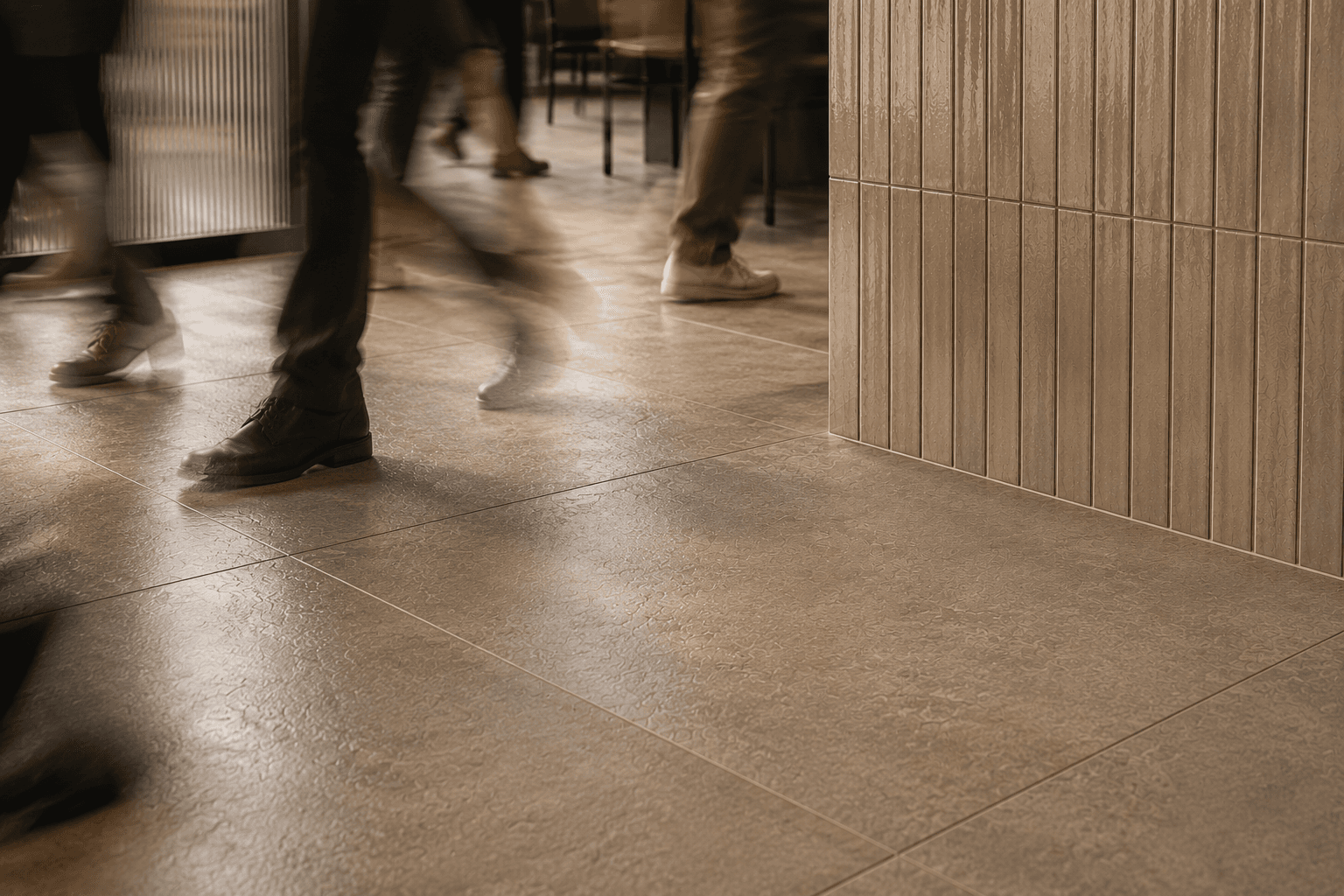
What is PTV? Understanding PTV slip ratings and slip resistance
When specifying floor tiles for commercial environments, slip resistance is an important consideration. Alongside colour, finish and material, the performance of a surface needs to suit how and where it will be used.
One of the key measures of floor tile slip resistance is PTV, or Pendulum Test Value. PTV slip ratings help architects, designers and specifiers understand the slip potential of a flooring surface in wet and dry conditions.
You’ll find PTV information across relevant Parkside product listings and brochures, helping you make a more informed specification.
Here, we explain what PTV means, how the pendulum slip test works, what a PTV of 36 means, and why wet and dry PTV results matter when specifying tiles for commercial spaces.
For project-specific guidance, our Account Managers can help you identify products suited to the requirements of your space.
What does PTV mean?
PTV stands for Pendulum Test Value, a measure used to indicate the slip resistance of a floor surface.
PTV is particularly relevant in commercial environments, where flooring needs to perform appropriately for its intended use. A hotel entrance, commercial kitchen and office, for example, can present very different conditions and levels of slip risk.
The pendulum slip test provides a measurable way of assessing how a floor surface performs under wet or dry conditions.
Several testing methods exist, with BS 7976 and UNE ENV 12633 among those used within the tile industry. Following testing, a Pendulum Test Value is recorded to indicate the slip potential of the surface.
Why are PTV slip ratings important?
Slip resistance is an important consideration wherever people move through a space, but the level of risk isn't consistent across every environment.
Entrances can be exposed to rainwater. Washrooms regularly encounter water. Hospitality spaces may be affected by spillages, while commercial kitchens introduce another set of conditions entirely.
Understanding PTV slip ratings can help specifiers make more informed flooring choices for these different applications.
Appropriate slip resistance can contribute to:
- safer environments for employees, visitors and the public
- meeting relevant health and safety requirements
- reducing the potential for slip-related incidents
- supporting the long-term suitability of a flooring specification
The important point is context. A PTV slip-resistance value shouldn't be considered in isolation; it should be assessed alongside the intended application and conditions of the space.
How does the PTV pendulum test work?
The BS 7976 pendulum test measures slip resistance using a swinging rubber slider designed to simulate a heel making contact with the floor.
As the slider passes across the surface, friction slows its movement. The equipment measures this loss of momentum and produces a Pendulum Test Value.
In simple terms, greater friction produces a higher PTV, indicating a lower slip potential.
Testing can be carried out in both wet and dry conditions, giving specifiers a clearer understanding of how a floor surface is likely to perform under different circumstances.
What do PTV slip ratings mean?
PTV results are used to indicate the slip potential of a flooring surface. A higher PTV generally indicates greater slip resistance and therefore a lower slip potential.
As a general guide under BS 7976:
0–24: High slip potential
25–35: Moderate slip potential
36+: Low slip potential
The conditions under which the product was tested are important, particularly when comparing wet and dry PTV results.
What does PTV 36 mean?
A PTV of 36 or above in wet conditions is commonly used as a benchmark for low slip potential in UK commercial environments.
For architects, designers, contractors and developers, however, the number is only part of the specification.
The expected use of the space, potential contamination, cleaning regime and other project-specific considerations should also inform product selection.
A tile shouldn't therefore be selected on its PTV rating alone. Its suitability needs to be considered in the context of the wider flooring specification and intended application.
What is a wet PTV rating?
A wet PTV rating measures the slip resistance of a surface when water is present.
This is particularly relevant because the slip resistance of a flooring surface can change significantly when it becomes wet.
During wet testing, water is introduced to assess how much grip the surface retains in conditions that can reflect rainwater, spillages or regularly wet environments.
Wet PTV results can therefore be particularly useful when considering tiles for spaces such as entrances, washrooms and other areas where water is likely to be present.
What is a dry PTV rating?
A dry PTV rating measures the slip resistance of a flooring surface under dry test conditions.
Most flooring surfaces achieve higher PTV results when dry. Even relatively smooth or polished surfaces can demonstrate good slip resistance in controlled dry conditions.
Dry PTV can therefore be relevant where a floor is expected to remain consistently dry.
However, relying on a dry PTV result alone may not give an accurate picture of performance where water, spillages or cleaning residues are likely to occur. Understanding the conditions of the space is essential when interpreting the result.
Where are PTV-rated tiles used?
PTV slip ratings are relevant across a wide range of commercial flooring applications, including:
- education
- hospitality
- retail
- transport
- leisure
- commercial kitchens
- washrooms
Different areas within the same project may also have different slip-resistance requirements.
An office floor, for example, won't necessarily face the same conditions as the building entrance. Similarly, a restaurant dining area and its commercial kitchen present very different environments despite being part of the same project.
Rather than applying one slip-resistance requirement across an entire building, flooring should be considered in relation to each space and how it will be used.
Are there other floor tile slip-resistance ratings?
PTV isn't the only method used to assess floor tile slip resistance. Depending on the product, application and project requirements, you may also encounter:
- DIN 51097 Barefoot Ramp Test
- DIN 51130 Shod Ramp Test
- Tortus Dynamic Test
- UNE ENV 12633 Pendulum Test
Different methods assess surfaces under different conditions. Barefoot areas, for example, present different considerations from environments predominantly used by people wearing footwear.
This is also why different tile slip ratings shouldn't automatically be treated as interchangeable. The testing method and intended application need to be understood alongside the result.
Our Account Managers can help you navigate the relevant product information and identify tiles suited to your project's requirements, with additional technical support available where needed.
Choosing slip-resistant tiles for commercial spaces
Slip resistance is one part of a wider flooring specification.
Material, colour and finish shape the design intent, while performance needs to respond to how the space will actually function. Bringing those considerations together helps create commercial interiors that work aesthetically and practically.
If you're specifying commercial floor tiles and need help understanding PTV ratings or identifying products suited to your project, our Account Managers can help you explore the options and understand the available product information.
Get in touch with the Parkside team to discuss your project.

