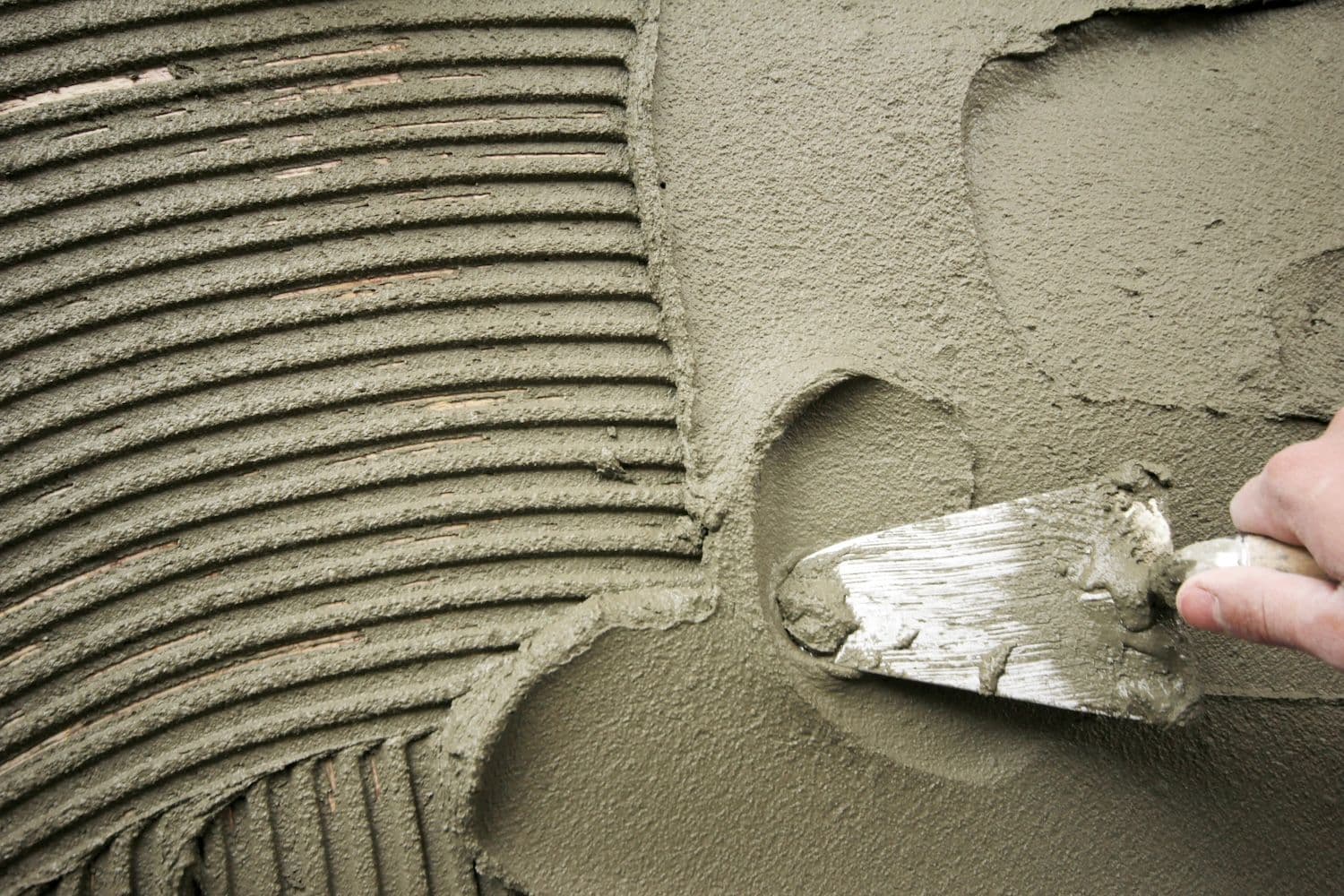
Flexible tile adhesive is formulated to accommodate a degree of movement between the substrate and the tile without the bond failing.
Ordinary tile adhesive is cement based, and once it sets it's completely rigid, a bit like concrete. That's fine as long as nothing underneath ever moves. But floors and walls do move, even if you can't see it happening: timber floors flex when you walk on them, underfloor heating expands and contracts the floor as it heats and cools.
Likewise, big temperature swings outdoors make surfaces expand and shrink with the seasons, which is a huge consideration when installing external tiles.
Flexible adhesive copes with that movement by bending slightly instead of staying totally stiff, so the tile stays stuck down instead of cracking, popping off or letting the grout crack.
It's made by adding polymers (a bit like a rubbery additive) into the standard cement mix, which gives it that extra flex.
It's graded S1 or S2 under British/European standards, with S2 having even more stretch than S1, for situations with more movement to deal with.
In this post, we’ll cover some of the most common scenarios which call for flexible tile adhesive.
Substrates Prone To Movement Or Deflection
Timber floors, plywood overlays and metal decking all flex under load in a way that solid concrete does not. A rigid adhesive on these substrates is likely to crack or delaminate as the tile and substrate move at different rates. Flexible adhesive absorbs this differential movement and is specified as standard on timber and metal substrates.
Underfloor Heating Installations
Underfloor heating causes cyclical expansion and contraction as the system heats and cools. This thermal movement places ongoing stress on the adhesive bed. BS 5385 recommends a flexible adhesive over underfloor heating for this reason, and the system should be commissioned and brought up to temperature gradually before tiling in line with the heating manufacturer's instructions.
Large Format Tiles
Larger tiles cover more of the substrate per unit, so any movement in the substrate is distributed across a wider bond area with less give. Flexible adhesive reduces the risk of lippage, cracking or edge curl on large format formats, and many manufacturers stipulate a minimum flexibility class once tile size exceeds a given threshold, typically 600mm.
External & Exposed Installations
External tiling, balconies and other exposed areas experience wider temperature swings and freeze-thaw cycling than internal spaces. This makes flexible adhesive necessary to prevent bond failure as the substrate and tile expand and contract at different rates through the seasons.
Natural Stone & Low Absorption Tiles
Denser porcelain and natural stone tiles have low water absorption, which affects how the adhesive cures and bonds. Many natural stone products are also prone to movement or are supplied with a degree of dimensional variation, and manufacturers commonly specify a flexible adhesive to accommodate this alongside a suitable non-staining formulation for light-coloured stone.
When Standard Adhesive Is Sufficient
On a stable, well-cured solid concrete or sand and cement screed, with standard format ceramic tiles and no underfloor heating, a standard (non-flexible) cementitious adhesive is typically adequate. Specifying flexible adhesive as a default across all installations is not necessary and adds unwarranted cost, so the substrate, tile format and any heating system should be assessed before selecting the adhesive class.
Checking The Adhesive Classification
Adhesive flexibility is defined under BS EN 12004: S1 denotes a deformable adhesive and S2 a highly deformable adhesive. Specifiers should confirm the required class against BS 5385 for the relevant application (floors, walls, wet areas or external work) and against the tile and substrate manufacturers' own guidance, as requirements can vary by product.
Need Advice?
Selecting the right adhesive is part of a wider specification decision that includes tile format, substrate and installation environment.
Parkside's range covers large format porcelain, natural stone effect and technical tile collections.
For professional guidance about your project, please get in touch with our team.

