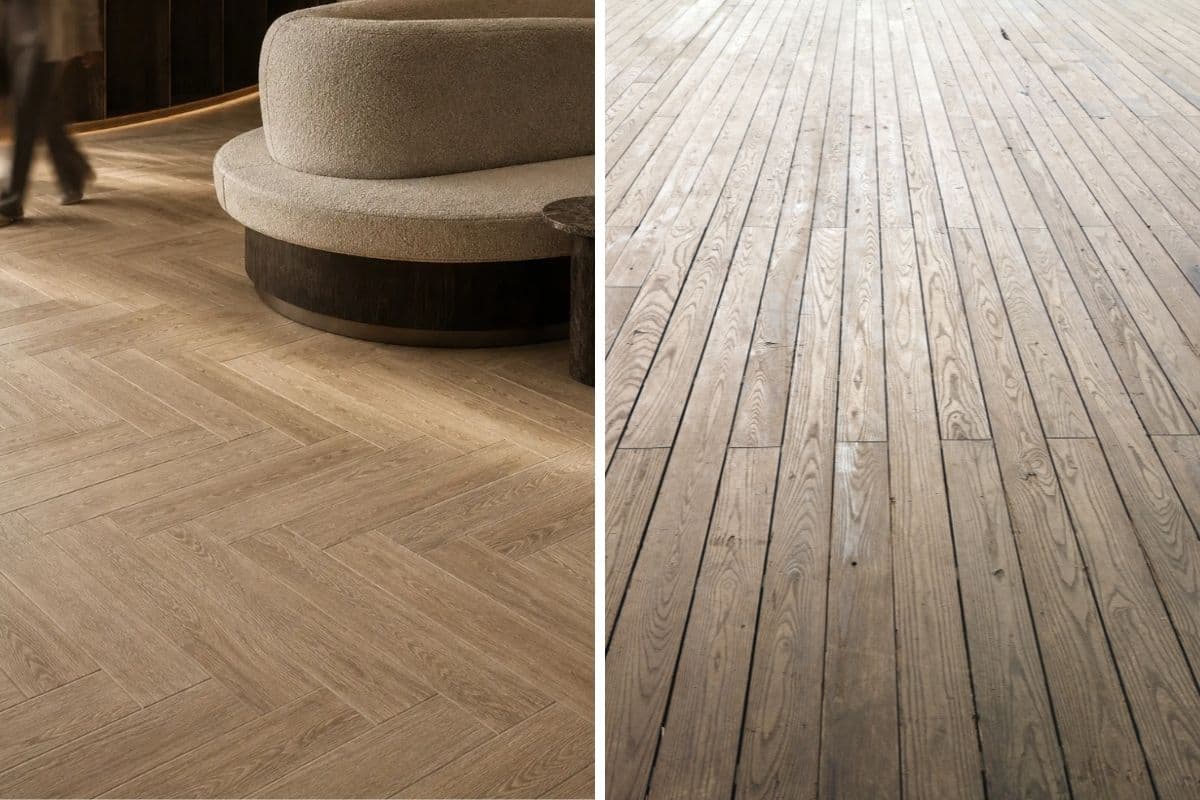
Wooden flooring offers a timeless appeal in terms of aesthetics. But when it comes to using real timber flooring, especially in a commercial setting, there can be a lot of drawbacks which rule it out.
Thankfully, wood effect porcelain has closed the visual gap considerably in recent years. The vast range of choice now available means specifiers can really hone in on material performance without having to compromise on aesthetics.
If you are looking to achieve the look of a wooden floor but within a porcelain tile for an upcoming project, this post will uncover the top factors that matter for a commercial floor specification.
Crucially, we’ll explain how opting for wood effect porcelain tiles can provide the visual appeal of real timber, but in a way which avoids many of the drawbacks.
Moisture Resistance
Real timber is hygroscopic. It absorbs and releases moisture depending on humidity and temperature, which causes it to expand, contract, cup or gap over time. In commercial environments with variable footfall, spills, cleaning regimes or proximity to entrances, kitchens or wet areas, this movement is a genuine specification risk. Engineered timber reduces the problem compared to solid wood but doesn't remove it.
Porcelain, by contrast, has a water absorption rate below 0.5% (BS EN 14411, group BIa), which means it doesn't expand, warp or stain from moisture exposure. Wood effect porcelain carries this same performance while replicating timber's grain, colour and texture through high-resolution digital printing. For any commercial floor with exposure to moisture, whether that's a hospitality kitchen, a retail entrance or a washroom-adjacent corridor, porcelain removes a failure mode that real timber can only partially manage.
Fire Rating (Euroclass)
Fire performance is classified under the Euroclass system (BS EN 13501-1), which rates materials from A1 (non-combustible) through to F. Porcelain tiles typically achieve A1 or A1fl for floor coverings, the highest classification available, since the material is fully vitrified and non-combustible.
Timber flooring sits considerably lower on the scale, generally Class D or lower depending on the species, finish and any fire-retardant treatment applied. For commercial buildings, particularly those subject to Building Regulations Approved Document B or specific fire strategy requirements for public, retail or hospitality use, this difference can rule timber out of a specification entirely in certain zones, such as escape routes or high-occupancy areas, regardless of how the space is meant to look.
Maintenance Cost Over a Building's Lifecycle
Real timber requires ongoing maintenance to stay serviceable: periodic sanding and refinishing, sealant reapplication and repair or replacement of boards damaged by moisture, wear or impact. In a commercial setting with continuous footfall, this maintenance cycle is more frequent than in a domestic one and each round of refinishing takes the floor out of use.
Wood effect porcelain needs routine cleaning but no refinishing, sealing or sanding. Its wear resistance is rated by PEI classification and commercial-grade porcelain is specified to withstand continuous heavy footfall without surface degradation. Over a typical building lifecycle, the absence of a resurfacing cycle is usually the single biggest driver of lower total cost of ownership, even where the upfront cost of a premium wood effect porcelain range is comparable to or higher than a timber equivalent.
Wear Resistance

Timber surfaces scratch, dent and mark under sustained commercial footfall, castor wheels or dragged furniture and the damage shows more visibly on real wood than on a printed surface.
Wood effect porcelain is rated by PEI classification for abrasion resistance and commercial-grade ranges are specified to withstand continuous heavy footfall without visible surface wear, since the pattern is fired into the tile rather than sitting on top of it as a finish.
Underfloor Heating Compatibility
Solid timber is generally unsuitable for underfloor heating due to the risk of movement and cracking under sustained temperature change and even engineered timber is restricted to a limited surface temperature range. Wood effect porcelain has high thermal conductivity and no moisture-driven movement, making it fully compatible with underfloor heating systems without the same temperature restrictions.
Installation

Timber flooring requires an acclimatisation period before laying to let the material adjust to ambient humidity, along with skilled fitting to manage expansion gaps and subfloor preparation.
Wood effect porcelain follows standard commercial tiling installation practice, with no acclimatisation period required, though movement joints and appropriate adhesive and grout specification still apply as with any large-format porcelain installation.
Sustainability
Timber is a renewable material, but a commercial floor has a finite working lifespan before boards need sanding back to bare wood or replacing entirely.
Wood effect porcelain has a long service life with no resurfacing cycle and many commercial ranges now carry recycled content and published Environmental Product Declarations (EPDs), giving specifiers documented sustainability data to work from.
Upfront cost
Real timber costs vary considerably by species, with premium hardwoods sitting well above standard porcelain pricing. Premium wood effect porcelain ranges sit in a comparable price bracket to mid to high end timber, so upfront cost alone rarely decides the comparison.
The more significant cost difference emerges over the building's lifecycle, once maintenance, resurfacing and replacement are factored in.
Discover Parkside’s Wood Effect Porcelain Tiles For Commercial Flooring Projects

Once the decision has been made that wood effect tiling is the right option for a commercial project, this is actually only the beginning of what to consider.That’s because in a commercial setting, everything from the slip resistance to the ease of maintenance all need to be factored into the actual product decision.
Here at Parkside, we stock a vast range of wood effect porcelain tiles for commercial floor and wall applications. Discover our products and order free samples on our website.
Or, to receive any help or advice with a commercial tiling project, please get in touch.

