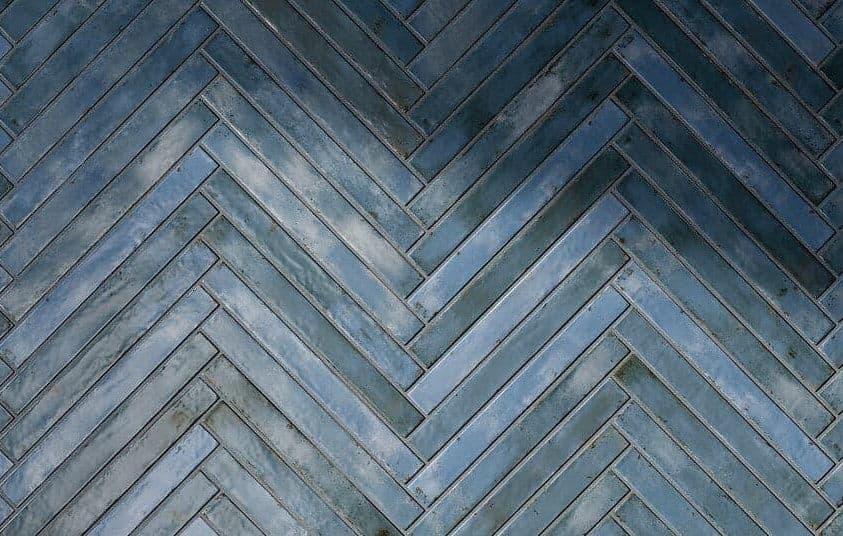
In tile specification, herringbone has become one of the most consistently requested laying patterns across residential and commercial projects.
Herringbone patterns are especially valued for the visual movement they bring to a surface and the way they transform standard rectangular tiles into something with real design intent.
Various tiles offer suitability to be used as herringbone tiles, whether on the wall or floor.
At Parkside, you will find many such tile ranges spanning endless materials and colours.
This guide is intended to help you understand where the herringbone pattern came from, along with tips on how to use herringbone tiles in your next project.
A Brief History of the Herringbone Pattern
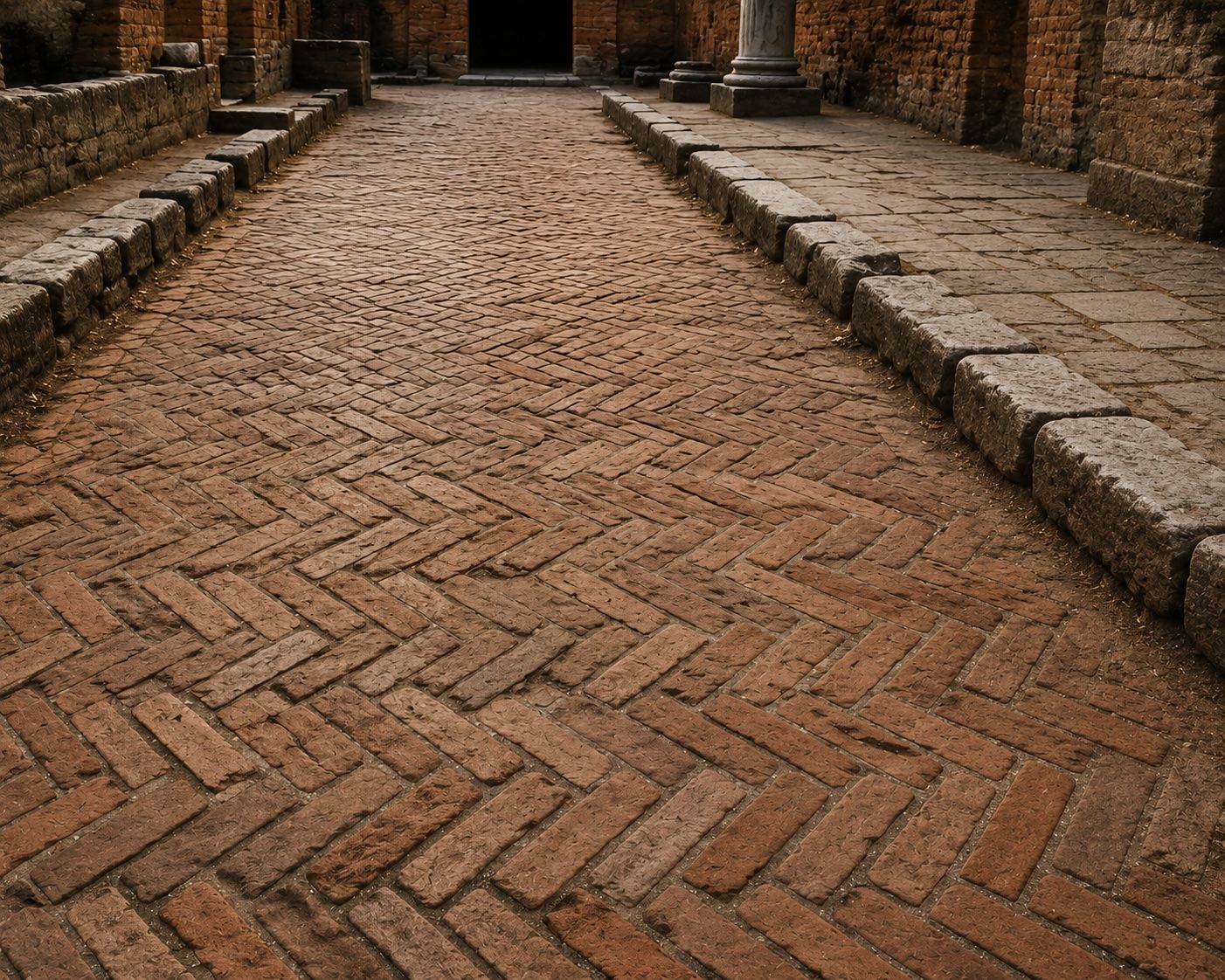
The earliest documented use of the herringbone was in Roman road construction, where builders discovered that laying bricks in a staggered V formation on a prepared gravel base produced a significantly more stable surface than laying them in parallel rows. The interlocking geometry distributed load across the width of the road rather than channelling it along a single axis, which made the surface more resistant to the concentrated pressure of wheels and livestock.
From Masonry To Interior Design
Herringbone's transition from a structural masonry pattern to a decorative interior feature happened during the sixteenth century in France.
One of the earliest surviving examples of herringbone as a deliberate interior design choice is the parquet floor installed in the Francis I Gallery at the Château de Fontainebleau in 1539. The gallery was one of the most prestigious interiors in Europe at the time and the choice of herringbone parquet was a statement of refinement as much as a practical decision.
Parquet flooring spread through French aristocratic interiors during the seventeenth century, where it became associated with the grandeur of palace building. The geometry that Roman engineers had used to build roads strong enough for legions was now being used to decorate the floors of Versailles.
From France, herringbone parquet spread to England and Northern Europe, where it remained a mark of quality craftsmanship through the eighteenth and nineteenth centuries.
However, the mid-twentieth century brought a period of decline. The availability of affordable fitted carpet from the 1950s onwards led to many historic parquet floors being covered over. Herringbone retreated from mainstream use and became associated primarily with period properties and formal institutional spaces.
Herringbone’s Contemporary Revival
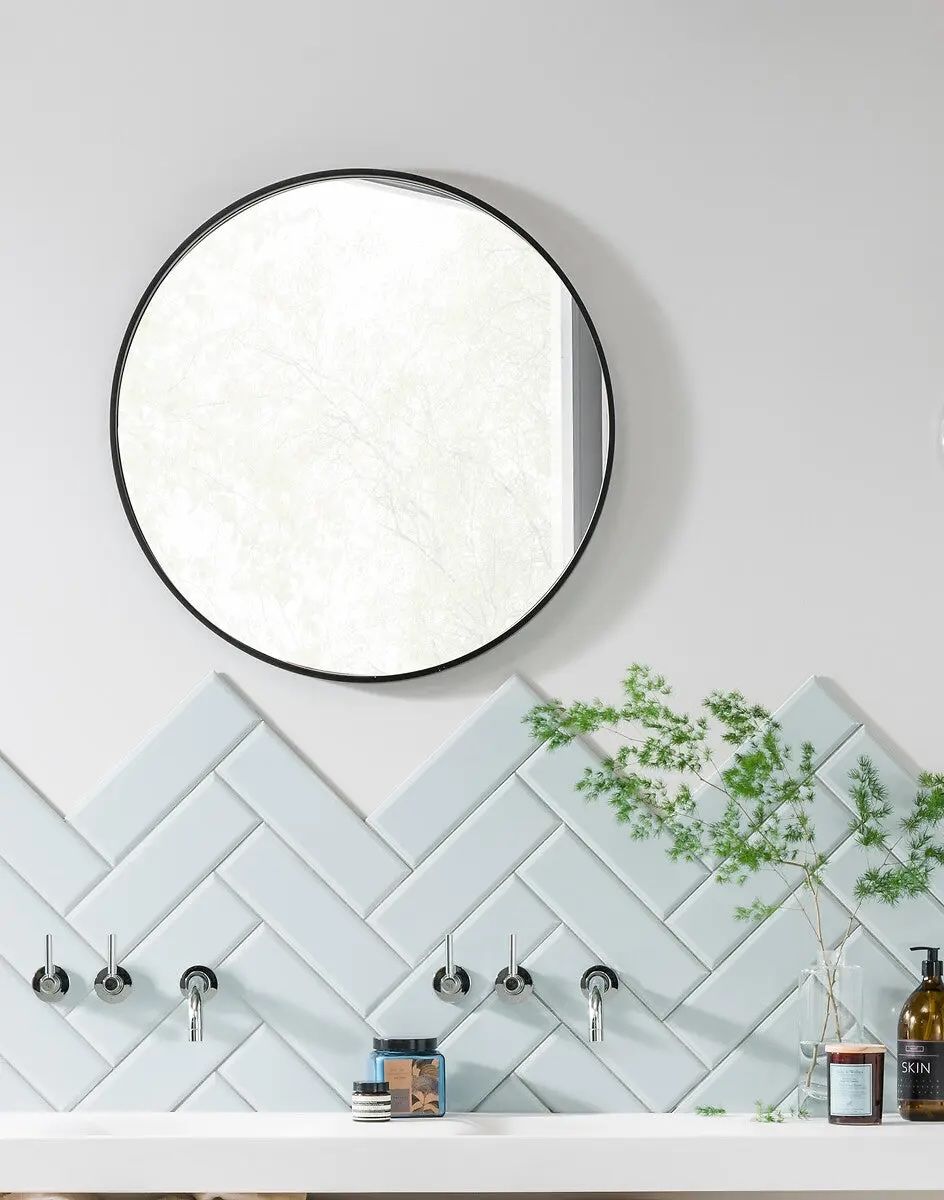
Shop the look:
The return of herringbone to mainstream interior design from the mid-2010s onwards was driven by several converging factors.
A broader shift in residential taste away from minimalist uniformity and towards pattern, texture and material depth created an appetite for laying patterns that do more than simply cover a surface. At the same time, the growth of large-format tile production made herringbone available in materials and scales that had not previously been possible.
Social media and the rise of design publishing platforms accelerated the pattern's visibility considerably. Once herringbone began appearing in aspirational kitchen and bathroom photography, the specification rate followed.
By the early 2020s, it had become one of the most requested tile laying patterns across both residential renovation and new-build commercial hospitality projects.
What distinguishes the current revival from earlier periods of popularity is the breadth of materials it now spans. Herringbone is no longer a wood or brick pattern translated into tile. Instead, herringbone is being specified in large-format porcelain, stone, terrazzo, encaustic and metro formats. It is also being applied to floors, walls and feature elements across every room type.
Why Herringbone Still Works
The herringbone pattern has endured across radically different design periods because it performs a range of spatial and visual functions that simpler laying patterns cannot.
Namely, herringbone:
- Adds movement to a static surface. The diagonal geometry of herringbone creates a sense of direction and energy that a straight lay or grid pattern does not. On a floor, this can make a room feel larger and more dynamic. On a wall, it draws the eye across the surface in a way that is engaging without being disruptive.
- Elevates standard tile formats. A plain metro or brick-format tile laid in straight rows is a background material. The same tile laid in herringbone becomes a design decision. The pattern does the decorative work, which allows the tile itself to be relatively simple without the result feeling understated.
- Has structural logic. The interlocking geometry that made opus spicatum so effective in Roman road construction also distributes stress more evenly across a tiled surface than a straight lay. In high-traffic floor applications, this can contribute to a more durable installation.
- Works across scales. Herringbone is equally effective with small mosaic tiles and with large-format porcelain slabs. The pattern scales up and down without losing coherence, which makes it versatile across different project types and room sizes.
What Tiles Are Best For A Herringbone Pattern?
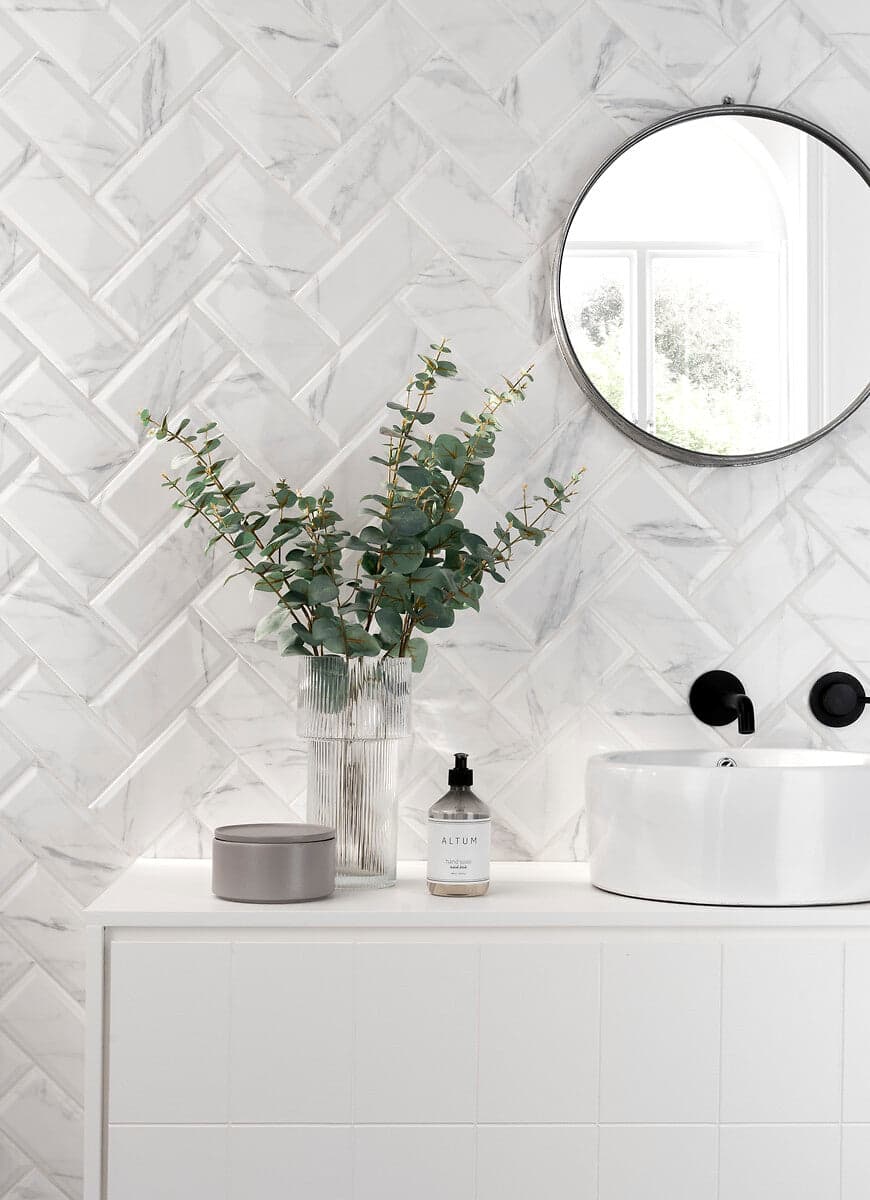
Shop the look:
Any rectangular tile can be laid in herringbone, but the pattern reads most clearly with tiles that have a length-to-width ratio of 2:1 or greater.
Standard metro tiles in 100x200mm or 75x150mm are the most common format used in wall applications.
For floors, brick-format porcelain in 100x200mm to 200x600mm works well.
Larger-format tiles in 300x600mm or 200x800mm are increasingly specified for contemporary schemes where a bold, graphic herringbone is the design goal.
How To Use Herringbone Tiles In Your Next Project
Herringbone works across almost every room and surface type, from kitchen splashbacks and bathroom floors to hallway entrances and feature walls. The pattern is versatile enough to suit a simple glazed metro tile and substantial enough to elevate a large-format porcelain slab. Here are some of the most effective ways to use it.
Herringbone Kitchen Tiles
Shop the look:
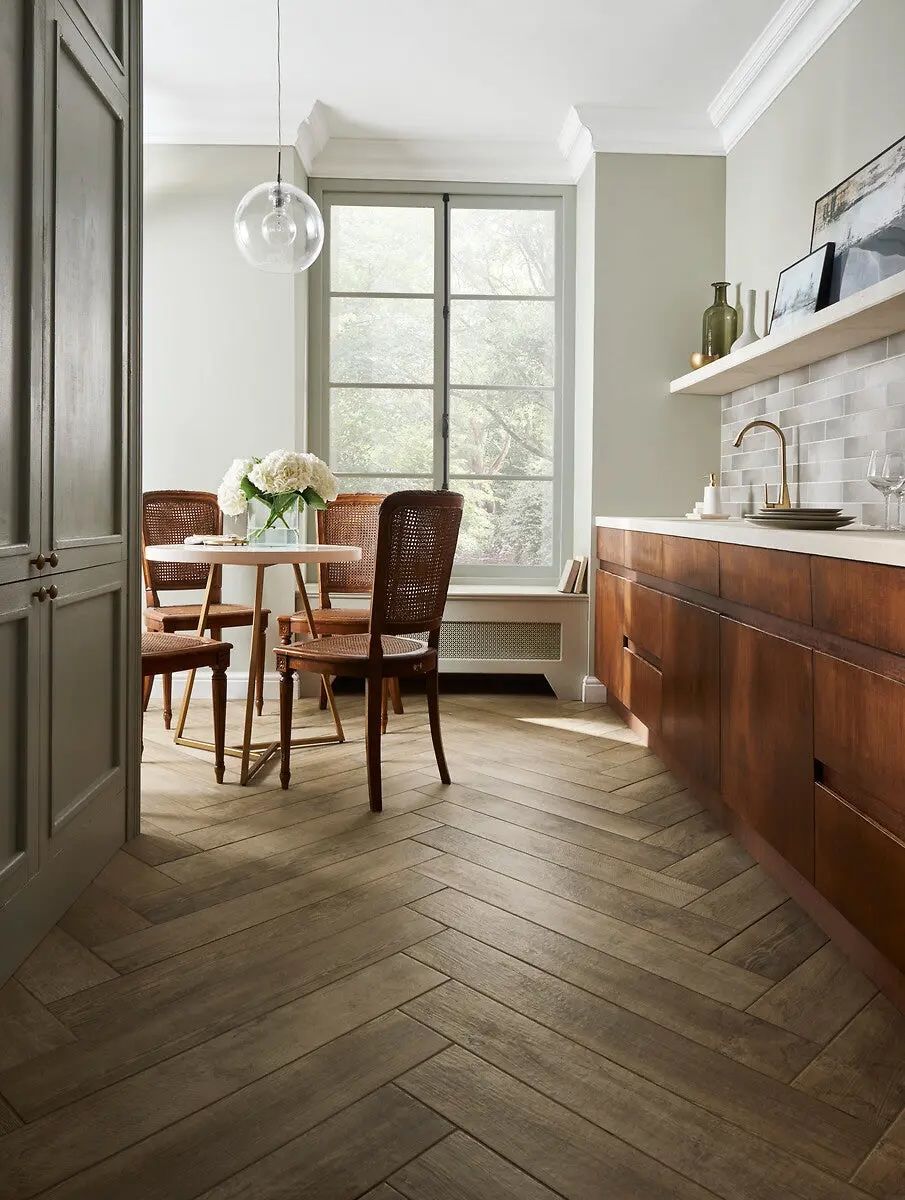
The kitchen splashback is where herringbone tiles are most frequently specified in residential projects and for good reason. The confined vertical surface suits a laying pattern that creates visual interest in a limited area, and the splashback is the one element in a kitchen that is expressly decorative as well as functional.
Metro-format tiles in a 100x200mm or 75x50mm format are the most common choice for kitchen herringbone. White and off-white glazed ceramics remain the most specified colour, but the pattern is increasingly being used in deeper tones: sage green, charcoal, navy and terracotta all read well in herringbone because the alternating orientation catches light differently across the surface and gives depth to a single colour.
On kitchen floors, larger-format porcelain in a brick or elongated rectangular format laid in herringbone produces a striking result that works particularly well in open-plan spaces where the floor is a significant visual element. A 200x400mm or 200x600mm porcelain tile in herringbone at 45 degrees creates a strong diagonal grid that anchors the space.
Herringbone Bathroom Tiles
Shop the look:
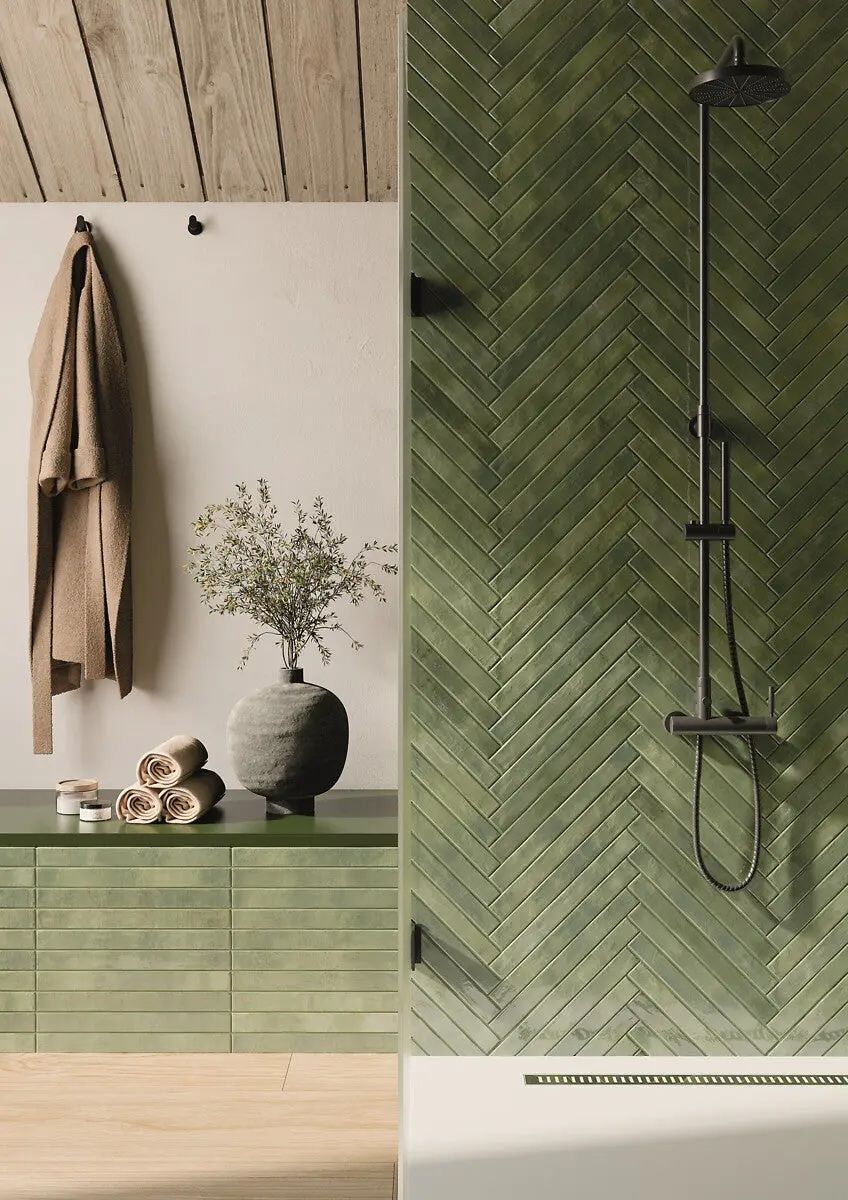
In the bathroom, herringbone works effectively in both floor and wall applications. On bathroom floors, small-format porcelain mosaics or encaustic cement tiles in herringbone create a period-influenced look that suits both traditional and contemporary schemes. The smaller the tile, the more intricate the herringbone geometry reads, which can be used to bring richness to a relatively small floor area.
In shower enclosures, herringbone wall tiles in a glazed ceramic or polished porcelain generate a reflective surface that varies in intensity as the viewing angle changes. This works particularly well in narrow shower enclosures where a single-colour straight lay would feel flat: the herringbone geometry gives the surface enough movement to hold the eye without introducing a second colour or material.
Natural stone in herringbone is one of the most specified combinations in premium bathroom work. Marble, travertine and limestone in a brick format laid in herringbone produce a result that references the material's historic use in European palace interiors while reading as completely current. The pattern amplifies the natural variation within the stone, as the alternating orientation means the veining or colour shift within each tile faces in a different direction, creating a continuous, non-repeating surface.
Herringbone As A Feature Element
Shop the look:
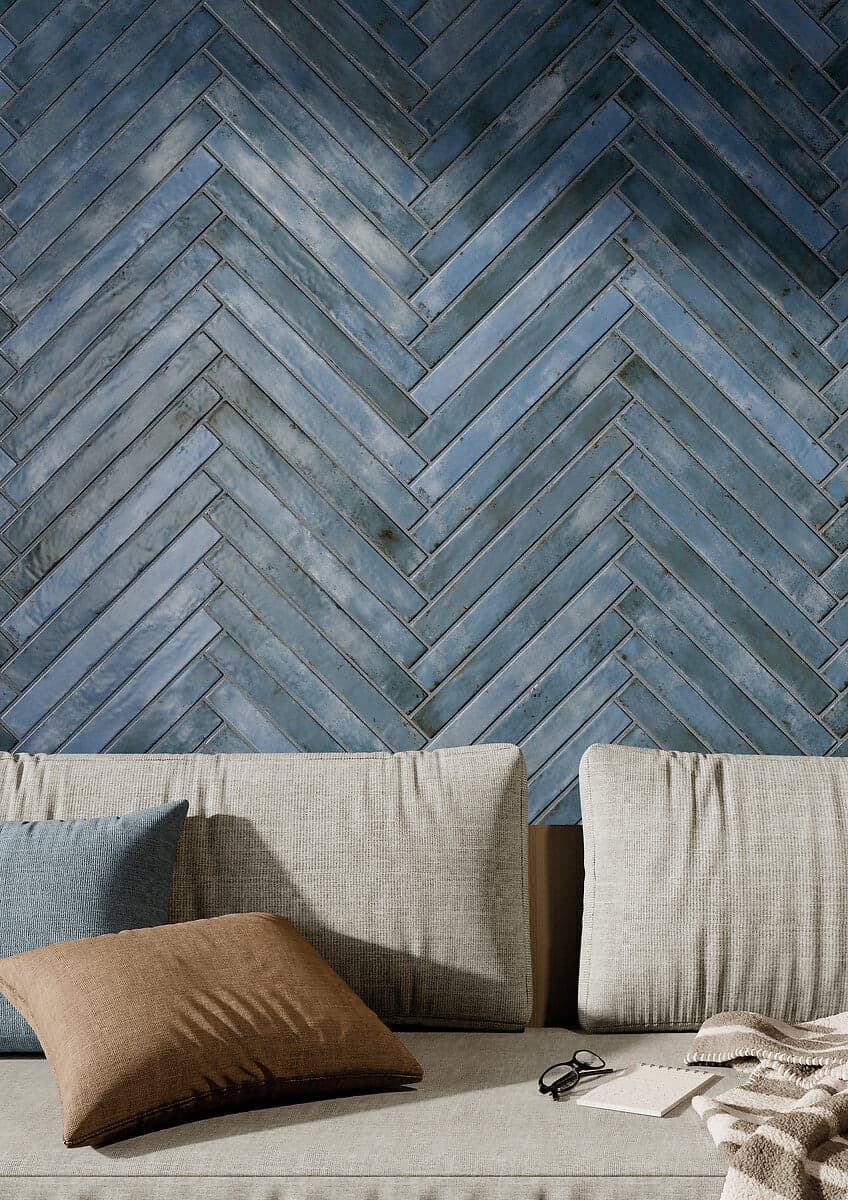
One of the most effective ways to use herringbone tiles is as a defined feature within a larger scheme rather than across the entire surface. A herringbone panel framed by a contrasting border tile creates a focal point with a formal, considered character. This approach works well behind a freestanding bath, as a recessed shower niche, as a section of kitchen splashback between cabinets or as a fireplace surround.
Used in this way, herringbone functions like a piece of considered detailing: the pattern is present and legible without dominating the room. A single herringbone panel in a contrasting tile against a plain field tile is a standard move in commercial hospitality design for this reason.
Herringbone Floor Tiles In Hallways And Entrance Spaces
Shop the look:
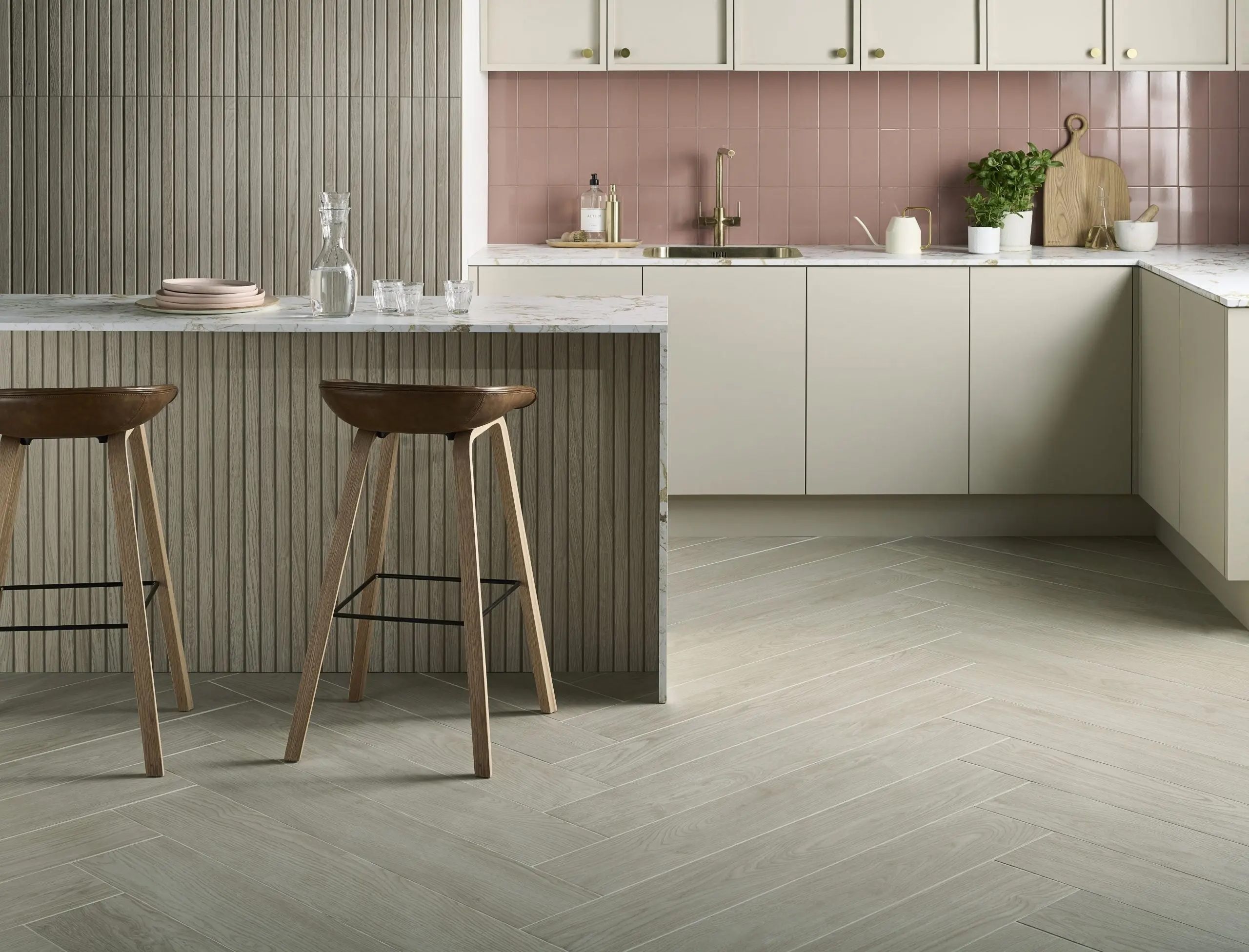
The hallway is historically one of the most natural settings for herringbone floor tiles, and it remains one of the most effective. The diagonal direction of the pattern encourages the eye to move forward along the length of a narrow space, which makes herringbone particularly well suited to the proportions of a traditional entrance hall or corridor.
Encaustic cement tiles in herringbone are the period reference point for this application, but contemporary porcelain in the same format produces a more durable and maintenance-free result. For a transitional scheme, a porcelain tile in a matt finish with subtle tonal variation reads as traditional without requiring the maintenance that genuine cement tile demands.
Specification Notes for Herringbone Tile Layouts
Herringbone layouts require more careful planning than straight lays and generate more waste at the perimeter. The following points are worth considering before specifying or ordering:
- Order additional tile. A herringbone at 45 degrees generates more perimeter cuts than a straight lay. A minimum waste allowance of 15% is standard for a diagonal herringbone; 10% is more appropriate for a vertical herringbone.
- Use rectified tile. Dimensional consistency is important in herringbone because any variation in tile length or width will cause the joints to drift out of alignment over a run. Rectified tiles, precision-cut to tight tolerances, are strongly recommended over non-rectified formats for herringbone layouts.
- Establish the layout centre before starting. In a 45-degree herringbone, the starting point and centre line of the pattern must be established across the full extent of the floor or wall before the first tile is fixed. Starting from a corner without setting out the full layout first is the most common cause of an uneven or poorly balanced finish.
- Consider grout joint width carefully. A narrow grout joint of 2mm to 3mm produces a cleaner, more contemporary result and is appropriate for porcelain. A wider joint of 5mm to 8mm suits more traditional or textured tiles and gives the pattern a more rustic character. The joint colour is as important as its width: a contrasting grout will emphasise every line of the pattern while a close-matched grout allows the tile colour to read first.
- Allow for movement joints. As with any tile installation, movement joints at perimeter edges and at intervals across large floor areas are required in accordance with BS 5385. The diagonal geometry of herringbone can make movement joint placement less visually intrusive, as the joints can be positioned to align with the tile edges rather than cutting across them.
Get Advice About Your Herringbone Tiling Project
At Parkside, our team has been supporting architects, designers and specifiers for over 40 years.
Whether you are planning a large commercial scheme or a single feature wall, we can help you select the right tile format, finish and laying pattern for a herringbone tiling project.
Let us know how we can help by sending us a message. You can also give us a call on 0116 276 2532.

