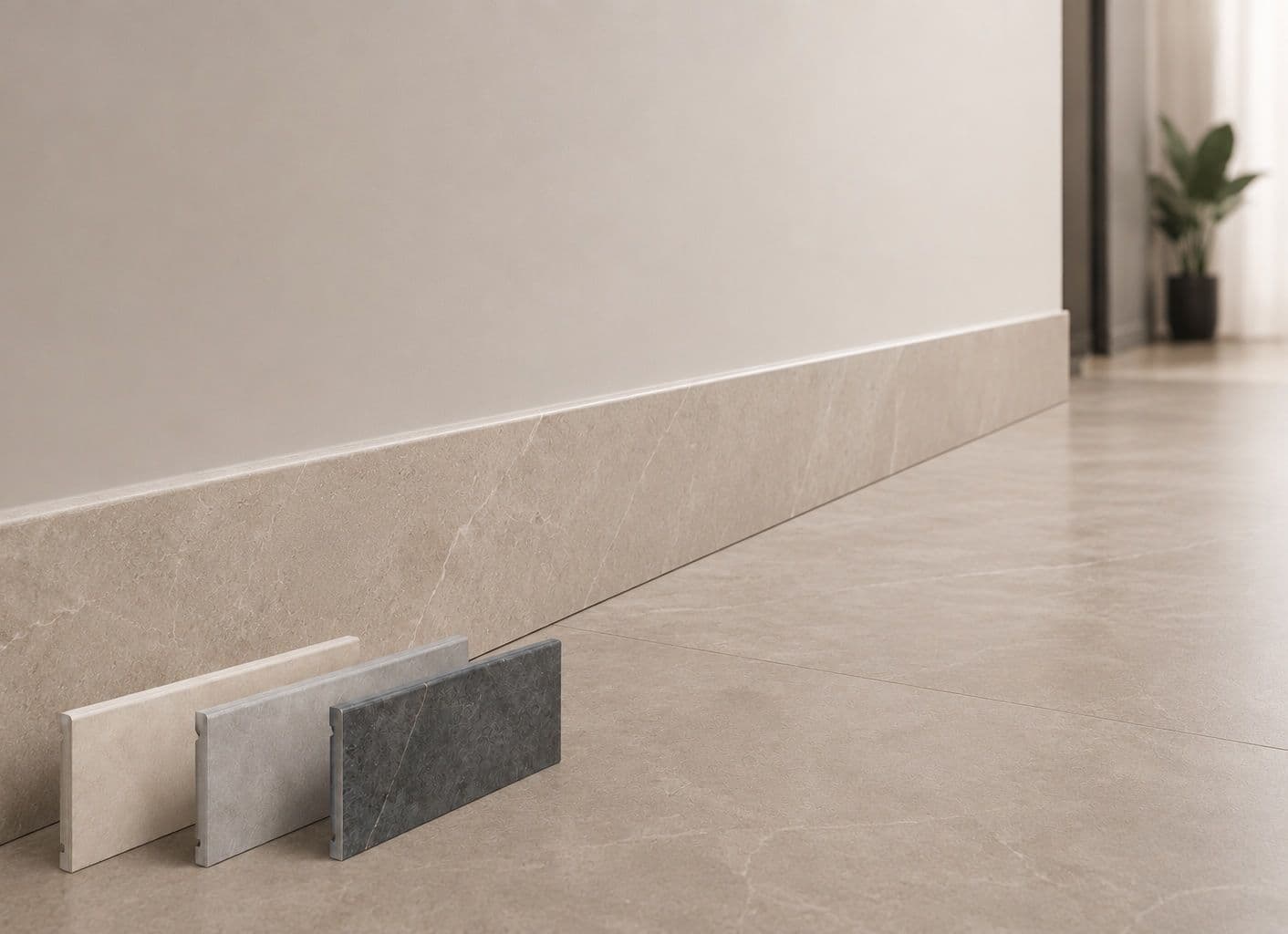
Tiled skirting is a wall base detail formed by running the same tile used on the floor up the wall to create a matching, flat skirting board.
Traditionally, timber skirting boards are used to cover the joint between a wall and a floor, especially in residential properties.
However, in most commercial settings, wooden skirting is unsuitable due to aspects such poor resistance to moisture, vulnerability to impact damage and difficulty meeting hygiene requirements in food or clinical environments.
Using tiles as skirting creates the ideal solution. Tiled skirting reimagines traditional timber skirting in ceramic or porcelain, creating a seamless finish that works particularly well in tiled spaces.
If you are considering incorporating tiled skirting into your next flooring project, here is an overview of how to do so, plus what to look out for from the tile specialists here at Parkside.
Skirting Tiles: An Overview

Tiled skirting, sometimes called tile skirting or skirting tiles, refers to a row of tiles installed at the base of a wall to create a neat, durable border between the floor and the wall surface.
Rather than using a separate timber skirting board, the transition is handled entirely in tile, which can be cut from the same material as the floor tiles. Or, it can also be supplied as purpose-made skirting tile profiles with a rounded or coved top edge.
The result is a continuous, cohesive surface that reads as part of the wider scheme rather than an afterthought. In rooms where the floor and wall tiles are the same product, tiled skirting creates an almost unbroken material finish from floor to wall, which feels considered and intentional in a way that a painted MDF skirting board rarely does alongside a tiled floor.
Where Is Tiled Skirting Used?
Tiled skirting boards are most commonly found in bathrooms, wet rooms, kitchens and utility rooms, where moisture resistance is a practical priority.
Timber skirting in a wet environment will swell, crack and eventually rot if it is not perfectly sealed and maintained. Tiles have no such vulnerability, as they can be wiped down, withstand condensation and will not be affected by water pooling on the floor.
Beyond purely functional spaces, tiled skirting has also become increasingly popular in contemporary residential and commercial interiors where a seamless, minimalist aesthetic is the goal.
In commercial settings such as restaurants, hotels, retail spaces and healthcare environments, tiled skirting is often specified as standard because it is easier to clean, more hygienic and far more durable than timber alternatives in high-footfall conditions.
What Are The Different Types Of Tiled Skirting?

There are a few different approaches to tiled skirting depending on the look you want to achieve and the tiles you are working with.
The most straightforward option is to use the same tile as the floor, cut down to a skirting height of around 70 to 100mm. This creates a very clean, continuous look and works well with large format tiles where the material can carry the detail without a profile being needed.
Purpose-made skirting tiles are an alternative that offer a finished top edge, typically with a gentle radius or cove profile that curves back into the wall. This coved detail is particularly common in commercial environments. That’s because the curved junction between floor and wall has no right-angle corners for dirt or bacteria to accumulate in, which makes cleaning significantly easier.
A third option is a pencil or bullnose tile, which provides a slim decorative border with a rounded edge. This works well as a transitional detail in bathrooms or kitchens where a subtle accent is preferred over a full skirting height tile.
Can Any Tile Be Used As Skirting?

Technically, any ceramic or porcelain tiles could be cut down and used as skirting. However, in reality, some tiles are better suited to the application than others.
The short answer is that the tile you have chosen for your floor can almost always be adapted for skirting use, but if the project demands a particular edge detail or finish, it is worth exploring dedicated skirting tile options from the outset rather than trying to engineer a solution from a tile not designed for that purpose.
So before selecting a tile to use as skirting, we recommend considering the following properties:
Thickness
Thicker tiles, particularly those designed for external use or heavy commercial foot traffic, can be difficult to cut cleanly into narrow skirting strips without chipping or cracking along the cut edge. A standard wall or floor tile in the 8 to 10mm thickness range will cut and finish more cleanly than a 20mm external paving tile, which is unlikely to be appropriate for an interior skirting detail, regardless of how it cuts.
Surface Finish
Highly textured or heavily structured tiles (i.e. those with a pronounced three-dimensional surface, deep grooves or a rough anti-slip finish) can look awkward at skirting height, where the texture reads very differently from how it does underfoot.
Instead, a lightly textured or smooth porcelain tends to work better as a skirting tile, particularly where the top cut edge will be visible. If the cut edge is going to be seen, a rectified tile with a precise, clean edge will give a more refined finish than a non-rectified tile, where the edge may be slightly uneven.
Tile Format
Very small mosaic tiles or irregularly shaped tiles can be used for skirting but require considerably more cutting and setting out to achieve a neat result, particularly at corners and returns. Larger format tiles cut down to skirting height are generally more straightforward to work with and produce a cleaner finish with fewer grout joints visible at floor level.
Purpose-Made Skirting Profiles
Where a truly finished edge is required (particularly in commercial settings where a coved skirting is specified), purpose-made skirting tile profiles are a better choice than cutting down a standard floor tile. These are manufactured with a factory-finished radius or cove on the top edge, which no amount of careful cutting on site can replicate. If hygiene, cleanability or a specific specification standard is a requirement, purpose-made profiles are also the right solution.
What Height Should Tiled Skirting Be?

There is no fixed rule, but most tiled skirting sits between 70mm and 150mm in height. In residential bathrooms and kitchens, 70 to 100mm is the most common range and broadly matches the visual weight of a standard timber skirting board.
In commercial settings with coved skirting, the height is typically 100 to 150mm to allow the cove profile to transition cleanly from floor to wall. However, it's also true that some types of commercial projects allow for more freedom over the skirting height, including to incorporate higher skirting designs.
The height you choose will also depend on your tile format. If you are using a large format floor tile and cutting it down for the skirting, the height will naturally be constrained by what produces a clean cut without excessive waste. A 600x600mm tile, for example, can comfortably yield a 100mm skirting piece with material left over for other cuts.
How Is Tiled Skirting Installed?

Tiled skirting is installed after the floor tiles are laid and grouted. The skirting tiles are fixed to the base of the wall using the same adhesive as the floor tiles, with a small expansion gap left at the junction between the skirting tile and the floor tile. This gap is filled with a flexible silicone sealant rather than grout, which allows for natural movement in the structure without cracking. Using rigid grout at this internal corner is one of the most common installation mistakes and will almost always lead to cracking over time as the floor and wall move independently.
Grout colour is also worth considering carefully. Matching the skirting grout to the floor grout creates the most seamless result, while a contrasting grout can be used deliberately to define the detail.
Are Tiled Skirting Boards Better Than Traditional Timber Skirting?

Obviously, traditional timber skirting offers a lot of charm, especially in Edwardian, Victorian or Georgian properties.
A benefit of using timber skirting is the lower cost and ease of installation. That’s because cutting and fixing skirting tiles requires more precision than fitting a length of timber or MDF skirting and any mistakes are harder to correct.
However, in commercial tile specification (including modern residential developments), timber skirting isn’t always the right fit. This can be in regard to aesthetics, but also due to practical considerations. For instance, timber skirting is vulnerable to moisture damage in bathrooms and kitchens. Likewise, timber may prove unsuitable for commercial environments that are subject to intense cleaning processes.
Therefore, in most cases, tiled skirting is more durable and easier to maintain. Using a tile for the skirting also creates a finish that feels far more cohesive when the rest of the floor and walls are also tiled.
Tiled Skirting Ideas For Your Project

For a minimal contemporary bathroom, matching the skirting tile exactly to the floor tile and keeping the grout joints perfectly aligned gives the cleanest possible result. Paired with wall tiles in a complementary colour or finish, this approach lets the floor and skirting read as a single surface.
In a kitchen or utility room, a contrasting skirting tile in a darker tone can anchor the room and add definition at floor level without competing with the wall finish above. This works particularly well with large format light stone effect floor tiles, where a charcoal or slate skirting provides a grounding detail.
For a more traditional interior, a cushion-edge or pencil tile in a metro or brick format can reference the character of a period home while still delivering the practical benefits of a tiled finish at floor level.
Skirting Tiles: The Key Advantages
- Matching material and finish across floor and skirting, avoiding colour or texture mismatch with painted or timber skirting
- Fully waterproof and impervious to moisture, suited to wet areas such as bathrooms, wet rooms and commercial washrooms
- No timber or MDF substrate, removing risk of swelling, rotting or warping in humid conditions
- Easier to clean and maintain than painted skirting, with no repainting or chipping to manage over time
- Consistent slip and impact resistance in line with the main tile specification, useful where wall protection is required in commercial or high-traffic areas
- Reduced dirt and dust trapping at the floor-wall junction compared with traditional skirting profiles
- Can be cut from the same batch as the floor tile, allowing precise colour and pattern matching, including for large-format or patterned ranges
- Suitable for underfloor heating installations without the movement issues associated with timber skirting
- Longer service life than painted or MDF skirting, particularly relevant for commercial specification where lifecycle cost matters
- Available in various heights and profiles (e.g. bullnose, coved) to suit different installation and hygiene requirements
Tile Skirting FAQs
We’ve answered some of the most popular queries about using tiles for skirting below.
However, if you’re involved in a commercial flooring specification, please reach out to our team to receive advice applicable to your project requirements.
Is Tiled Skirting Better Than Coving?
As with any flooring specification, it really depends on the environment. It’s also not uncommon for a specification to use a mix of both.
In general, coved skirting is the better choice for hygiene-critical or wet areas such as commercial kitchens, washrooms and clinical spaces. That’s because its seamless curved profile removes the joint where dirt, moisture and bacteria can collect.
Tiled skirting suits commercial spaces where appearance and durability matter more than eliminating every joint, such as offices, retail units and hotel corridors. That’s because a tile can be chosen to match the existing floor tile exactly and tiles will also hold up well to everyday wear.
What Hygiene Regulations Apply to Commercial Kitchen Floor And Wall Junctions?
The main requirement comes from Regulation (EC) 852/2004 on the hygiene of foodstuffs, which sets out that floors and walls in food preparation areas must be maintained in a sound condition and be easy to clean and, where necessary, disinfect. That includes the junction where floor meets wall, which is why a seamless detail such as coved skirting is the standard specification choice, as it removes the corner joint where dirt, moisture and bacteria could otherwise collect.
Parkside's technical team can advise on the right junction detail and tile specification for your project.
What's The Best Skirting Option For a Tiled Commercial Floor?
For most commercial floors, tiled skirting is the better match, as it uses the same tile as the floor and reads as a continuation of it rather than a separate detail. It's durable against everyday foot traffic, trolleys and general wear and it keeps the specification consistent when ordering finishes for the same scheme. Coved skirting remains the better choice where hygiene is the primary driver, such as kitchens or clinical areas, so the right option depends on whether the space is hygiene-critical or general commercial use.
What's The Best Skirting Detail for a Hotel Bathroom?
Coved skirting is generally the stronger choice for hotel bathrooms, since the seamless curved junction is easier to keep watertight and hygienic in a wet, high-turnover environment. Where the bathroom sits within a wider scheme that prioritises visual consistency with the floor tile, such as a high-end ensuite, tiled skirting can work provided the junction is properly sealed. The decision often comes down to how wet the area gets in daily use and how closely the finish needs to match the rest of the room.
How Do You Finish the Floor to Wall Junction in a Retail Unit?
Retail units aren't typically hygiene-critical in the way kitchens or washrooms are, so tiled skirting is the more common choice, matching the floor tile and standing up well to footfall, trolleys and general retail wear. Coved skirting is worth considering in back-of-house areas such as stockrooms or any space with washdown cleaning, but for the main shop floor, a tiled skirting that continues the flooring specification is usually the simplest and most durable option.
What Skirting is Suitable for a Changing Room Wet Area?
Coved skirting is the standard choice for changing room wet areas, as the seamless junction handles constant moisture and washdown cleaning without a joint for water to collect in. It also supports the slip-resistance and drainage detailing typically required in these spaces. Tiled skirting is better suited to the dry-side areas of a changing facility, such as lockers or corridors, where matching the floor tile matters more than eliminating every joint.
Discuss Your Tiled Skirting Requirements With Our Tile Specialists
Parkside supplies a wide range of porcelain and ceramic tiles suitable for tiled skirting projects, from large format stone-effect tiles to purpose-made coved skirting profiles.
Browse our tile collections on our website, or get in touch with our specification team for project advice.
Or, to speak with our commercial tile specification team directly, please call us on 0116 276 2532.

