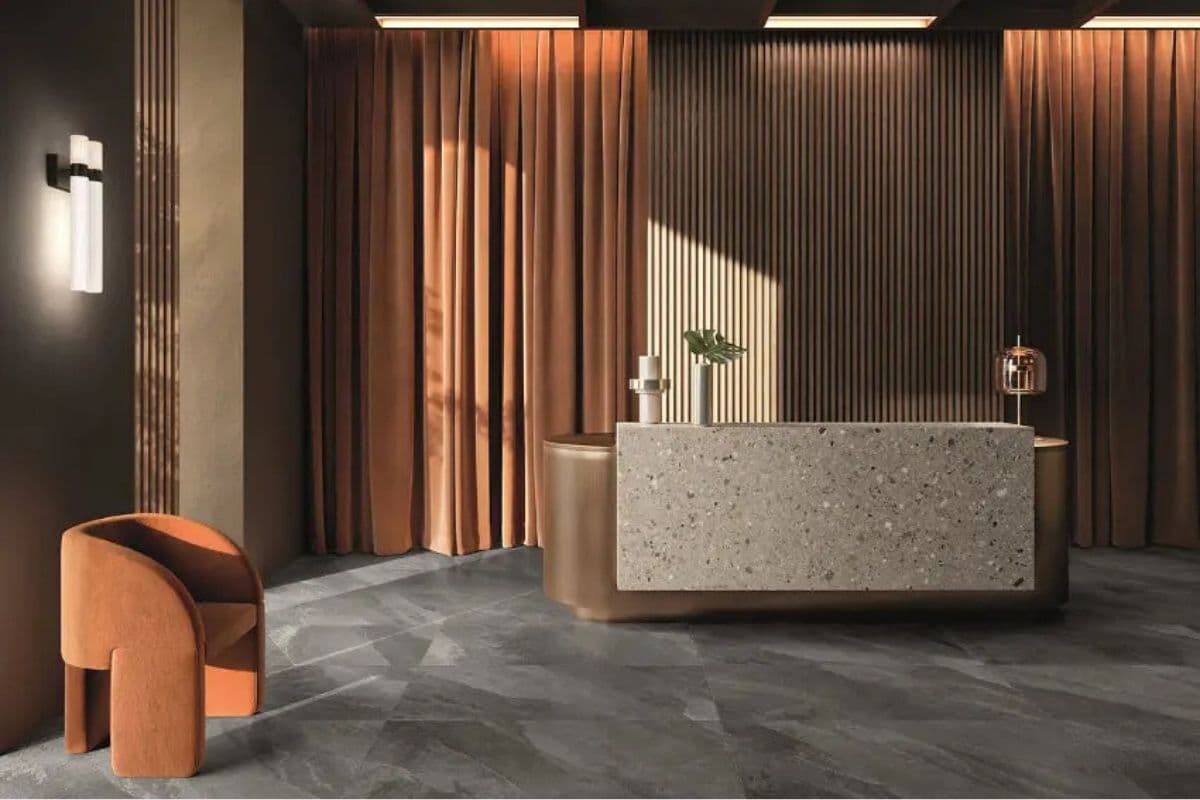
Here at Parkside, we commonly assist with tile specifications for commercial environments such as offices, retail stores and hotels.
Every type of commercial setting has its unique facets. Namely, varying footfall patterns, wet area exposure, aesthetic brief and maintenance regime all vary by sector. As a result, each of these factors changes the landscape of the tile specification.
If you are involved in the design or redevelopment of a commercial space, our specifiers can provide you with tailored advice regarding suitable tiling options.
For now, we’re here to provide you with a generalised guide on choosing tiles for offices, retail stores and hotels, which happen to be some of the most popular commercial environments we supply tiles for.
What Changes Between Sectors
Commercial tile specification is often treated as a single discipline, but the requirements shift considerably depending on the building type.
An office, a retail store and a hotel all fall under the same broad commercial category, yet each presents a different combination of footfall, moisture exposure, wear demands and aesthetic brief.
Understanding how these factors diverge by sector is the starting point for getting the specification right, rather than defaulting to a generic commercial standard that may underperform in one setting and be unnecessarily over-specified in another.
Offices

Shop the look:
Offices see steady, predictable footfall concentrated around entrances, circulation routes and washrooms, with comparatively low exposure to standing water outside welfare areas.
The specification priority is usually wear resistance in high-traffic zones and slip resistance in washrooms and entrance transitions.
Another top consideration for offices is acoustic performance, especially in open-plan spaces where hard flooring increases reverberation.
Retail Stores

Shop the look:
Retail stores carry higher and more variable footfall. This includes frequent wheeled loads from trolleys and stock movement. Likewise, entrance zones that see far greater water and grit ingress during wet weather than a typical office.
As a result, abrasion resistance and impact resistance both need to be specified toward the top end of the scale, while slip resistance at entrances needs to account for a wet, contaminated surface far more often than an office would.
Learn more about how we used the Elvert tile collection for our Office Westfield project by reading our case study.
Hotels

Shop the look:
Hotels combine several distinct micro-environments under one roof: public circulation and lobby areas closer to retail in footfall and finish expectations, guest bathrooms with barefoot wet use and back-of-house or kitchen areas with commercial catering demands.
The aesthetic brief tends to carry more weight here too, since finish and material choice contribute directly to guest experience. However, this can't come at the expense of the technical requirements each zone carries.
Learn more about how we used the Regal tile collection for our Hilton Garden Inn Heathrow project by reading our case study.
Wear Resistance: PEI Rating by Sector
Glazed tiles are rated on the PEI scale from 0 to 5 based on visible surface wear under standardised abrasive testing, with unglazed tiles measured by material volume removed under the same conditions to BS EN ISO 10545-6 (glazed) and BS EN ISO 10545-7 (unglazed).
- Office: PEI IV is generally sufficient for circulation routes and open-plan areas, moving to PEI V for main entrances and reception.
- Retail: PEI V as a baseline across the shop floor. A PEI III tile in a heavy retail environment will show visible glaze wear within months and worn glaze cannot be restored, only retiled.
- Hotel: PEI V for lobbies and public circulation; PEI III to IV is workable for guest rooms and lower-traffic corridors where footfall is lighter and more controlled.
Slip Resistance: Where the Real Differences Are
All three sectors reference the same UK testing framework (Pendulum Test Value to BS 7976, with DIN 51097 for barefoot wet use), but the required zones and thresholds differ sharply.
- Office: PTV 36+ wet is the standard minimum for washrooms and any entrance transition zone. Main circulation areas away from wet sources carry lower practical risk but should still be checked against dry PTV.
- Retail: PTV 36+ wet at all entrances as standard practice, with consideration for consistently wet conditions during poor weather. Food and beverage concessions within retail settings should be treated as commercial kitchen wet areas.
- Hotel: Public areas and lobbies follow the PTV 36+ wet standard. Guest bathrooms and wet rooms require DIN 51097 Class B or C for barefoot wet use and pool or spa facilities carry their own separate testing requirements under BS 7976-2 and EN 15288-1.
Adhesive and Grout Selection
Tile performance is only ever as good as the fixing system behind it and sector-specific loads change what's appropriate.
- Office: Standard flexible cementitious adhesive (C2 to BS EN 12004) is generally adequate outside wet areas, where a waterproofed tanking system should be specified beneath the adhesive bed.
- Retail: Heavier footfall and wheeled loads make a C2 or higher flexible adhesive the practical minimum, with epoxy grout preferred in entrance zones and food concessions for its resistance to staining and chemical cleaning agents.
- Hotel: Fixing specification needs to vary by zone within the same building. Public areas can follow retail-level specification, guest bathrooms need waterproof tanking behind a C2 adhesive and pool or spa areas require the fully waterproof, chemically resistant system used in swimming pool applications.
Aesthetic Considerations by Sector

Shop the look:
Technical performance sets the floor, but the aesthetic brief is where these three sectors diverge most visibly.
Offices tend toward large-format, low-pattern porcelain that supports a calm, neutral backdrop to fit-out and branding elements.
Retail environments often use tile as an active part of brand identity, with bolder colour, pattern or feature wall applications in changing rooms and display zones.
Hotels, particularly in hospitality and leisure settings, frequently specify 3D wall tiles, wood-effect ranges and stone-look porcelain to create a sense of material richness in guest-facing areas, while keeping back-of-house specification purely functional.
Further Information For Choosing Commercial Sector Tiles
The ranges above give a working baseline for each sector, but a single building will often contain multiple zones with different requirements within it, particularly for hotels.
Where a project spans wet and dry areas, high and low traffic zones or public and back-of-house space, each zone should be specified against its own requirements rather than applying one standard across the whole scheme.
For a full breakdown of the technical standards referenced here, including abrasion, slip resistance and adhesive classification in detail, see our commercial tile specification guide.
For wet area specification in bathrooms, pools and commercial kitchens, our guide to tiles for commercial wet areas covers the requirements in more depth.
Hotel-specific ranges can be browsed on our hotel tiles collection and our PTV and slip ratings guide explains the testing methodology referenced throughout this guide.
Planning A Commercial Project? Talk To Our Tile Specification Team

Shop the look:
If you are involved in the design or redevelopment of a commercial space, then there are many factors to consider when choosing tiles, whether for internal walls and floors or external areas of the building.
For any help or advice, contact our tile specialists today by completing our contact form. Or, you can speak with us directly by giving us a call on 0116 276 2532.
You are also welcome to discover our tile ranges in person at one of our design studios located across the UK. These can be found in Glasgow, Manchester, Leicester and London.

