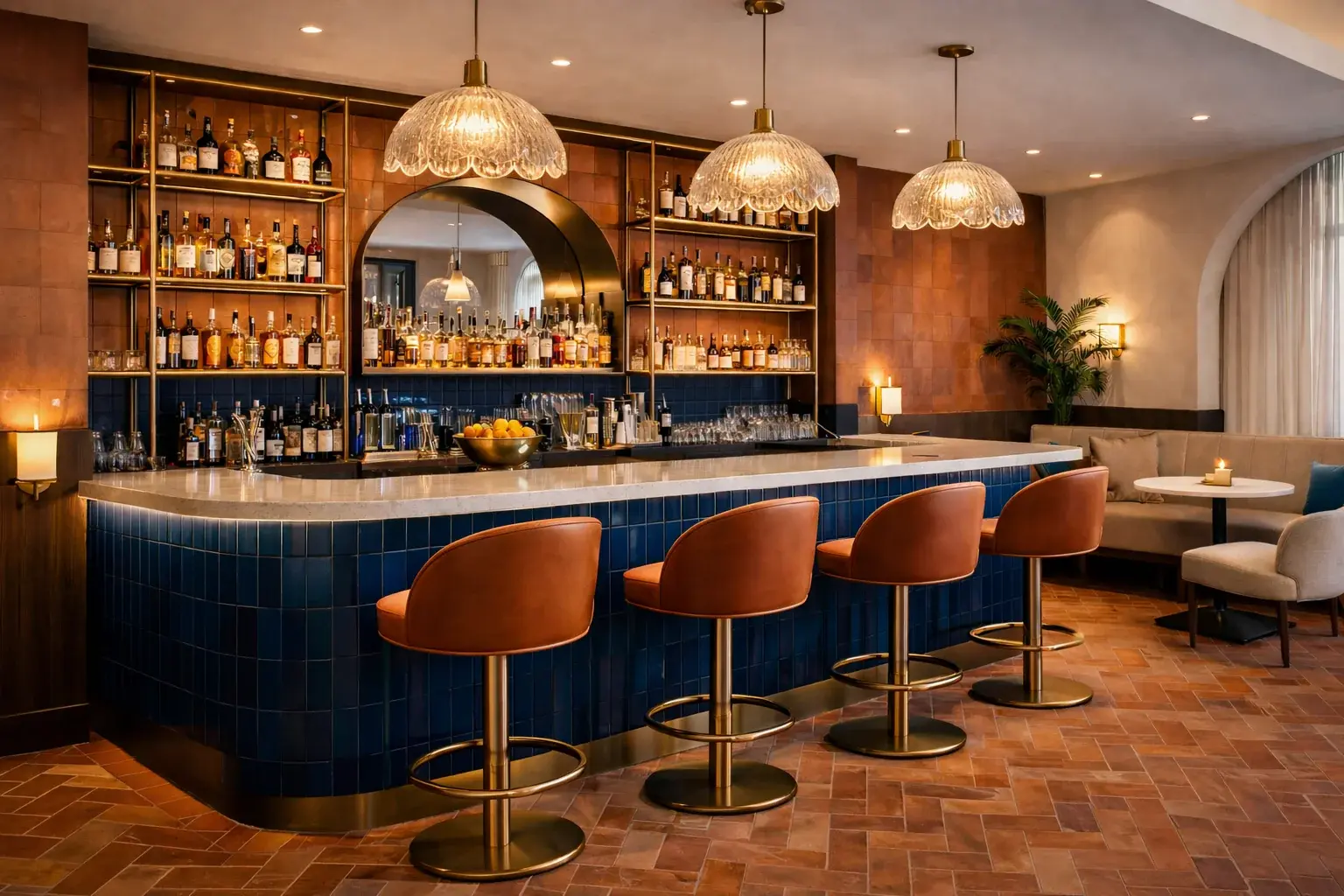
In commercial venues such as a pubs, bars and nightclubs, interior surfaces need to work hard to not only look the part, but most importantly, keep up with the demands that will be placed upon them.
Tiles are one of the few finishes that can handle all of these challenges while still giving designers full control over the look of the venue.
Parkside has supplied tiles for hospitality venues right across the UK. Our specification team can provide you with tailored advice for a similar commercial project when you get in touch.
For now, here is an overview of why tile is a sound choice for these types of environments and how to make good specification decisions zone by zone.
Tile collection featured in cover image: Alicante
Why Tiles Are a Good Choice for Pubs, Bars and Nightlife Venues

Above image: Parkside supplied the tiles for The Cumberland Hotel’s new VIP Lounge
The case for tile in licensed venues comes down to whole-life performance. For instance, floors must withstand the likes of spilt drinks, broken glass, sticky residues and thousands of footsteps a night. Walls and bar fronts get knocked by stools, kegs and glass collection trolleys. Carpet, timber and vinyl all have a place in hospitality, but each struggles somewhere in a busy bar.
Porcelain tiles in particular solve most of the problems these venues face:
Impervious to liquid: Fully vitrified porcelain absorbs 0.5% water or less (group BIa under BS EN 14411), so spilled beer, wine, spirits and soft drinks sit on the surface rather than soaking in. That means no lingering odours and no staining in the tile body.
Built for intensive cleaning: Tiles tolerate daily wet mopping, scrubber driers and commercial detergents. Carpet and timber degrade under the same regime.
Long service life: A correctly specified porcelain floor can outlast several refurbishment cycles of the furniture and decor around it, which keeps down the cost of closures for floor replacement.
Rated slip performance: Slip resistance is a measured, documented property of a tile, so operators can show they have assessed and controlled the risk.
Fire performance: Ceramic and porcelain tiles are non-combustible and classed A1 for reaction to fire, which supports the fire strategy in crowded late night spaces.
Design range: Wood, stone, concrete, terrazzo and patterned effects let a venue achieve a traditional pub, a cocktail bar or an industrial club look without compromising on performance.
Ease of repair: A damaged tile can be cut out and replaced without relaying the whole floor, provided spare stock from the same batch has been kept back.
The Functions Tiles Must Provide in Licensed Venues
A tile in a bar is doing several jobs at once. Each one maps to a test standard, so a specification can be checked against data rather than appearance.
| Function | Why it matters in these venues | What to check |
|---|---|---|
Slip resistance | Floors are wet with spills for most of the trading day, often in low light and with customers who have been drinking | Wet PTV to BS 7976-2; 36 or above is the HSE low slip potential threshold |
Liquid and stain resistance | Beer, red wine, cola and syrups stain porous materials and leave odours | Water absorption to ISO 10545-3; stain resistance to ISO 10545-14 |
Abrasion resistance | Grit from outside, stools and heavy footfall wear glazed surfaces | PEI class to ISO 10545-7 for glazed tiles; deep abrasion to ISO 10545-6 for unglazed porcelain |
Impact and breaking strength | Dropped bottles, kegs and glass crates | Breaking strength to ISO 10545-4 |
Chemical resistance | Daily cleaning chemicals, drain cleaners and citrus in cocktail stations | Chemical resistance to ISO 10545-13 |
Hygiene | Bar service areas and toilets need surfaces that clean back fully | Low porosity tile plus epoxy grout in wet and service zones |
Fire performance | Crowded spaces with late night occupancy | A1 reaction to fire classification |
Acoustic control | Hard floors raise reverberation, which pushes music and voices louder | Acoustic underlay and absorptive ceilings and walls as part of the wider scheme |
Visual identity | The floor and bar front set the character of the venue | Format, finish and effect chosen against the brand brief |
Slip resistance deserves the most attention. A polished or high gloss floor may look right in a cocktail lounge, but once wet it can fall well below 36 PTV. Our PTV and slip ratings guide explains how pendulum testing works and how to read the results on a data sheet.
Spaces Within a Venue That Can Be Tiled
A single pub or club contains several distinct zones and each one asks something different of the tile. Specifying zone by zone avoids a floor that is overbuilt in one area and underperforming in another.
Entrances and Lobbies

The entrance takes rain, outdoor grit and the heaviest concentration of footfall. A structured or textured finish with a high wet PTV is the priority here, combined with a recessed entrance matting system to stop water being carried further into the venue.
Bar Service Area (Behind the Bar)

The floor behind the bar is the most demanding surface in front of house. Staff are on their feet for long shifts, ice and drinks hit the floor constantly and glass breakage is routine. Specify a high wet PTV, epoxy grout, a coved skirting or sealed floor to wall junction and falls to a floor gully where drainage is planned.
Bar Fronts and Bar Tops

A tiled bar front is often the focal point of the room. It takes kicks from feet and knocks from stools, so a tile with good impact resistance and a glaze that wipes clean suits it well. Brick, metro, zellige style and 3D relief tiles are popular choices. Tiled bar tops are possible but grout joints at drinking height need care, so large format porcelain or sintered slab is usually the better option.
Back Bar and Feature Walls

Walls behind the bar and around booths carry the brand identity of the venue. With no foot traffic, the full range of glazes, gloss finishes and decorative formats is open, although surfaces near the service area should still resist splashes and frequent cleaning.
Main Drinking and Seating Areas

Above image: Parkside supplied tiles for The Hunter’s Moon in Chelsea, London
The main floor balances appearance with wear. Wood effect porcelain is a common choice for pubs wanting a traditional feel without timber's vulnerability to spills, while stone and concrete effects suit contemporary bars. Wet PTV and abrasion data still need checking, as drinks are spilled here throughout service.
Dance Floors

Above image: Parkside supplied the tiles for Cococure bar in Aldgate
Nightclub dance floors combine high crowd density, low light and frequent spills. A dense porcelain with a structured surface and a high wet PTV is the starting point. Tile colour and LRV affect how the floor reads under coloured and strobe lighting, so it is worth testing samples under the actual lighting rig.
Commercial Kitchens

Venues serving food have a kitchen that requires its own specification, including grease contaminated slip resistance, thermal shock resistance and epoxy grout throughout. Our commercial kitchen tiles collection covers these requirements in detail.
Toilets and Washrooms

Above image: Parkside supplied the tiles for Juno Rooms in London
Customer toilets in late night venues see some of the toughest cleaning regimes in hospitality. Floor to ceiling wall tiling, a slip-resistant floor, epoxy grout and coved junctions make washrooms quicker to clean and harder to damage. Anti-bacterial glazes are an option where hygiene is a particular concern.
Beer Gardens, Terraces and Smoking Areas

Outdoor trading space has grown in importance for pubs and bars. External areas need frost resistant porcelain with a wet PTV of 36 or above, usually in a 20mm format that can be laid on pedestals or a bound bed.
See our external 20mm porcelain range for terrace and courtyard options. Matching internal and external tiles let a bar floor run visually through to the terrace.
How to Make Good Tile Decisions for Your Venue

Featured project above: Marriott Hotel, Kensington
Good decisions start with the venue plan, not the sample board. Working through these steps keeps the specification tied to how each space is actually used.
Zone the floor plan: Mark each area by its exposure: dry, occasionally wet, constantly wet, contaminated (grease or syrups) and external. Each zone gets its own performance target.
Set the slip resistance target per zone: Use wet PTV as the primary measure and aim for 36 or above wherever floors are likely to be wet in use. Ask for the test report, not just a rating on a brochure and check whether the figure is for the exact finish you are specifying.
Choose the most suitable material: Porcelain suits almost every floor zone thanks to its low water absorption and density. Glazed ceramic works well on walls and bar fronts. Natural stone needs sealing and more maintenance in spill-heavy areas.
Match the finish to the zone: Polished and gloss finishes belong on walls and low risk areas. Matt, structured and textured finishes belong behind the bar, at entrances, on dance floors and outdoors. Many ranges offer several finishes in the same colour, so one look can run through the venue with the grip changing by zone.
Think about format and grout lines: Large formats reduce grout joints and speed up cleaning. Smaller formats follow drainage falls more easily and add grip through extra joints. Behind the bar and in toilets, specify epoxy grout so joints resist staining and chemicals.
Plan the details: Coved skirtings, drainage falls, movement joints, trims at changes of level and tactile or contrasting nosings on steps all affect safety and cleaning as much as the tile itself.
Consider maintenance from day one: Agree the cleaning method and chemicals with the operator before choosing a finish. A structured tile that is cleaned with the wrong equipment can lose its slip performance over time.
Check the substrate: Older pubs often have uneven, timber or contaminated floors. Substrate preparation, decoupling membranes and the right adhesive class matter as much as the tile choice, especially for large formats.
Order attic stock: Keep 5 to 10% spare tiles from the same production batch so damaged tiles can be replaced without a visible mismatch.
For a more in-depth breakdown of the standards referenced here, see our commercial tile specification guide.
Or, for toilets and cellar areas see our guide to tiles for commercial wet areas.
Pub, Bar & Nightlife Venue Tiles FAQs
Are you looking for help with choosing the right tiles for your pub, bar or other hospitality venue? If you don’t see your query below, please reach out to speak with our tile specification team.
What is the Best Flooring for a Pub?
Porcelain tile is one of the most practical options for pub flooring. It resists spills and staining, copes with intensive cleaning and is available in wood, stone and heritage effects that suit traditional pub interiors. Specify a wet PTV of 36 or above for areas where drinks are served and carried.
What Slip Rating do Bar Floors Need?
HSE guidance treats a wet PTV of 36 or above as low slip potential. Behind the bar, at entrances and on dance floors, where floors are wet most of the time, it is sensible to aim well above that minimum and to confirm the figure on the test report for the exact finish.
Is Tile a Good Choice for Nightclub Flooring?
Yes, provided the finish is chosen for wet conditions. Dense porcelain handles crowd loads, spills and nightly cleaning and it is non-combustible. Structured finishes give grip on dance floors, while LRV and colour should be checked under the venue's lighting.
Can You Tile a Bar Front?
Absolutely! A tiled bar front is a durable and popular feature. Choose a tile with good impact resistance, fix it to a rigid, stable substrate and finish exposed edges with trims to protect against knocks from stools and feet.
Should Bar Areas Use Epoxy Grout?
Epoxy grout is recommended behind the bar, in toilets, cellars and kitchens. It is impervious to liquids and resists staining from drinks and degradation from cleaning chemicals, where standard cementitious grout tends to discolour and break down.
Specify Tiles for Your Next Hospitality Project
A well specified tile scheme lets a pub, bar or club look the part on opening night and keep performing years later.
Our bar tiles collection brings together slip-rated ranges suited to service areas and front of house floors. Likewise, venues with a dining areas can compare options in our restaurant tiles range.
If your project spans several zones, our specification team can help match each area to the right tile, finish and performance data.
To begin a project with us or receive tailored advice, please get in touch.

